Shade Sail vs Pergola vs Retractable Awning — Which Is Right for You?
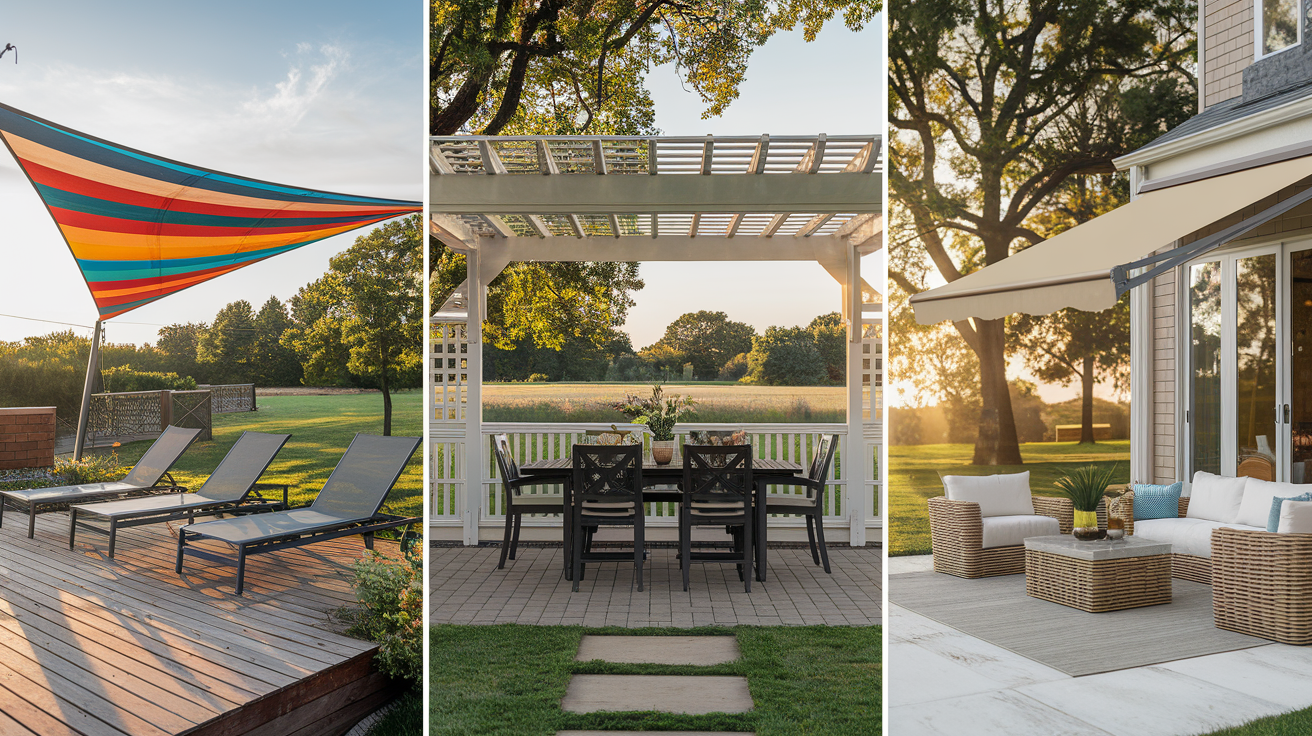
A shade sail costs $100–$400 and takes two hours to hang. A pergola costs $1,500–$6,000 and takes a weekend to build. A retractable awning costs $800–$3,500 and installs in an afternoon. The right choice depends on your budget, how much sun control you actually need, and whether you rent or own your home — and this breakdown will get you to the right answer in under five minutes.
I’ve put up all three in various backyards over the years, and the “which is better” question is almost always the wrong framing. They solve different problems. Here’s how to figure out which one solves yours.
The Short Answer: Which One Should You Buy?
- Renter or small budget? → Shade sail
- Permanent outdoor room, own your home? → Pergola
- Want full sun/shade control without construction? → Retractable awning
- HOA-restricted or want zero permanence? → Shade sail or freestanding awning
Shade Sail: The Flexible, Budget-Friendly Option
Shade sails are tensioned fabric panels — usually triangles or rectangles — strung between anchor points like fence posts, trees, or wall-mounted hardware. They block 90–98% of UV rays depending on the fabric density, and they come down in under 20 minutes when a storm rolls through.
Who Shade Sails Are Actually For
Shade sails make the most sense if you:
- Rent your home or might move in the next 2–3 years
- Have a small patio or deck (under 200 sq ft) that doesn’t need full coverage
- Want to cover an area with awkward geometry — a triangle sail can fill spots a pergola never could
- Need seasonal shade only (spring through fall)
- Are on a tight budget but want real UV protection
Top Shade Sail Picks
The most important spec is the HDPE density rating — look for 185 GSM or higher for serious UV protection. Cheap 150 GSM sails degrade in two seasons.
Coolaroo 16′ x 16′ Square Shade Sail — Coolaroo uses commercial-grade 185 GSM HDPE fabric with a 10-year UV warranty. The stainless steel D-rings hold tension without deforming, and the neutral sand/charcoal color options blend with most backyards. This is the shade sail I’d put on my own deck. Check current pricing on Amazon →
Sunnykud 12′ x 12′ Triangle Shade Sail (3-Pack) — Three triangles in complementary colors let you create layered coverage with dramatic visual effect. The polyester reinforced edges resist fraying better than most entry-level sails. Good for covering irregular spaces or creating a boho aesthetic over a fire pit area. See the 3-pack on Amazon →
Windscreen4less 20′ x 20′ Square Shade Sail — One of the few residential shade sails that legitimately covers a 400 sq ft area in a single panel. The 185 GSM fabric is tight enough to block serious afternoon sun. You’ll need beefy anchor points for this size — 4×4 pressure-treated posts minimum. View on Amazon →
Shade Sail Hardware — Don’t Skip This
The sail itself is almost never the failure point. It’s the hardware. Cheap turnbuckles and D-rings strip out or rust in one season. Spend $30–$60 on proper stainless steel tensioning hardware and your sail will last a decade.
Shade Sail Hardware Kit with Stainless Steel Turnbuckles — Grab a kit that includes 3/16″ wire rope, thimbles, and 304 stainless hardware so everything matches. Shade sail hardware on Amazon →
Shade Sail Pros and Cons
| Pros | Cons |
| Lowest upfront cost ($100–$400) | Doesn’t handle rain — pools water in center |
| No permits required | Must come down in high wind or snow |
| Renter-friendly (takes two bolts to mount) | Limited coverage area per panel |
| Easy to swap colors/configurations | Requires proper tensioning to look good |
| UV protection up to 98% | No lighting or fan integration |
Pergola: The Permanent Outdoor Room
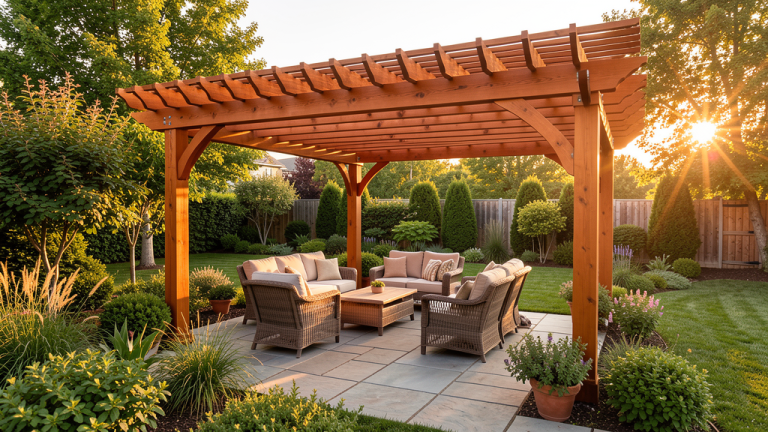
A pergola is a freestanding or attached structure with vertical posts and an overhead lattice or beam roof. It defines your outdoor space, adds measurable home value (typically 5–15% ROI on the outdoor entertainment area), and gives you a framework to hang fans, lights, curtains, and eventually a solid or louvered roof panel system. This is the endgame upgrade for serious outdoor living.
We’ve covered the full breakdown of pergola costs in our poolside pergola ideas guide — check that for design inspiration once you’ve decided on the structure. If you’re in Texas specifically, our best pergolas for Texas heat guide covers which materials hold up in extreme climates.
Pergola Materials: What Actually Matters
The material choice affects maintenance burden more than anything else:
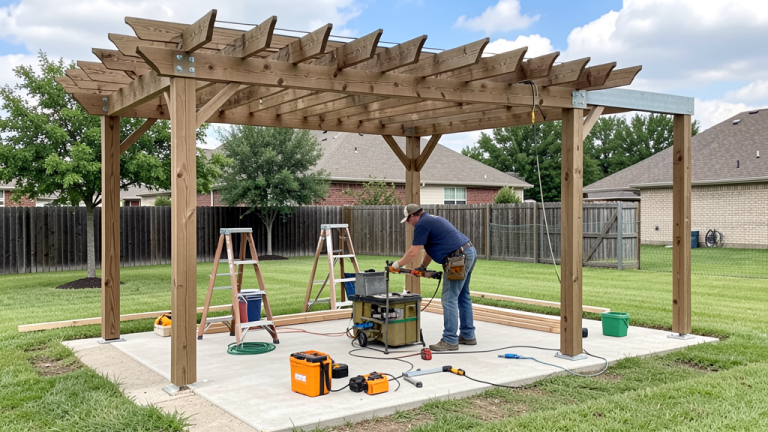
- Wood (cedar, redwood, pressure-treated pine): Beautiful, accepts stain/paint, but requires sealing every 2–3 years. In humid climates, cedar is worth the premium over pine for rot resistance.
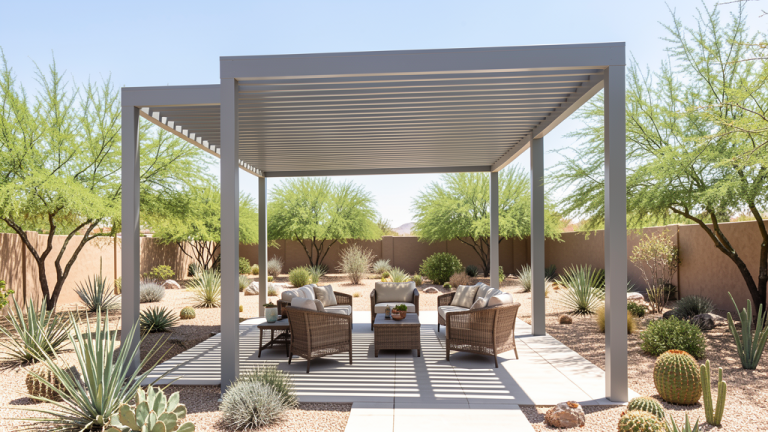
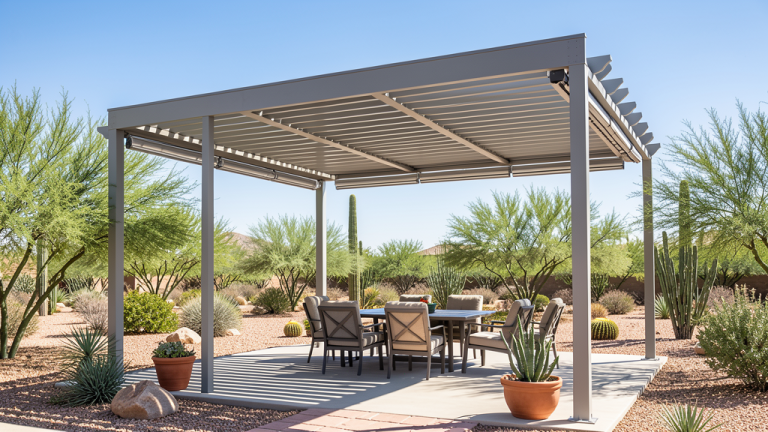
- Aluminum (powder-coated): Zero maintenance, rustproof, stays cool in most climates. Modern aluminum pergolas look just as good as wood. Best for wet climates or anyone who never wants to sand and restain.
- Vinyl: Cheapest option that requires zero maintenance. Looks fine from a distance but feels hollow and cheap up close. Skip it unless budget is the only factor.
- Fiberglass: The premium option — looks like wood, weighs less than wood, never rots or warps. Price-to-longevity ratio is excellent if you’re keeping the house long-term.
Best Pergola Kits to Buy in 2026
PURPLE LEAF 13′ x 10′ Aluminum Pergola with Retractable Canopy — This is the pergola I’d buy for a mid-size deck. The powder-coated aluminum frame has a 10-year structural warranty, the retractable canopy adds real rain and sun control, and the installation requires no concrete — just deck anchors. Ships assembled in major sections with clear instructions. Check PURPLE LEAF pergola pricing →
VEVOR 12′ x 10′ Steel Frame Pergola with Canopy — VEVOR’s steel pergola offers exceptional rigidity at a price point well below most aluminum competitors. The powder-coated finish handles outdoor conditions well, and the included canopy cover provides real shade coverage. Solid choice for anyone who wants a solid structure without the premium brand markup. See VEVOR pergola kits →
Sunjoy 12′ x 14′ Steel Hardtop Pergola with Adjustable Shade Panels — If you want the closest thing to a permanent structure without hiring a contractor, the Sunjoy hardtop is the answer. The galvanized steel roof is rated for snow loads, the adjustable louver panels let you dial in sun exposure, and the overall footprint creates a real outdoor room. This is where the pergola category starts eating into what you’d otherwise hire out. View Sunjoy hardtop pergola on Amazon →
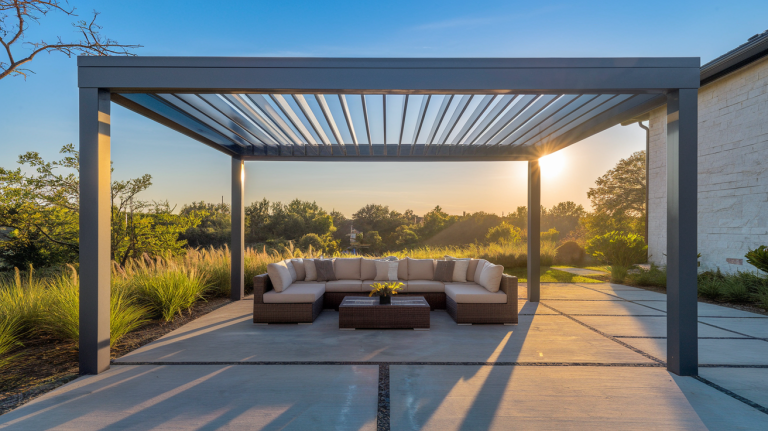
VEVOR Louvered Pergola 10′ x 13′ with Adjustable Roof — The adjustable louver version from VEVOR lets you go from full open to full closed in seconds. This is the feature that makes a pergola genuinely weather-adaptive rather than just decorative. Browse VEVOR louvered pergolas →
Do You Need a Permit for a Pergola?
In most U.S. jurisdictions, freestanding pergolas under a certain footprint (often 200 sq ft) don’t require a permit. Attached pergolas that connect to your home’s structure almost always do. Check with your local building department before ordering — the answer takes one phone call or email and saves you from tearing down work.
HOA rules are a separate layer. Many HOAs require style approval on pergolas even if the city doesn’t require a permit. Get it in writing before you build.
Pergola Pros and Cons
| Pros | Cons |
| Adds home value (5–15% ROI) | Highest upfront cost ($1,500–$6,000+) |
| Creates a true outdoor room | May require permits or HOA approval |
| Supports fans, lights, curtains, heaters | Basic lattice roof doesn’t stop rain |
| Long lifespan (20–50 years with proper materials) | Not renter-friendly |
| Highest design flexibility | Requires installation effort (1–2 days) |
Retractable Awning: On-Demand Shade Without the Construction
A retractable awning mounts to your home’s exterior wall or fascia and extends a fabric canopy on a spring-loaded or motor-driven arm system. When you want sun, it retracts. When you want shade or need to protect outdoor furniture from rain, it extends. The coverage angle is fixed (usually a 5–15° pitch for water runoff), but within that constraint, it’s the most flexible shade solution you can install on a rented or owned property.
Manual vs. Motorized Awnings
Manual crank awnings work fine for widths up to 10–12 feet. Beyond that, or if convenience matters (and it does — you’ll use the awning 10x more if it’s one button push), get a motorized model. The price difference is $200–$500, which is recovered in how often you actually use the thing over its lifespan.
Higher-end motorized awnings include wind sensors that automatically retract the awning when gusts exceed 25–30 mph. This matters — an extended awning in an unexpected storm can tear the fabric and damage the housing. The sensor pays for itself the first time a thunderstorm rolls in while you’re out.
Best Retractable Awnings in 2026
SunSetter 900XT 12′ x 10′ Motorized Retractable Awning — SunSetter is the brand name in residential retractable awnings for good reason. The 900XT uses a 100% solution-dyed acrylic fabric (Sunbrella or equivalent) that won’t fade for 10+ years, the arm mechanism has a lifetime warranty, and the motorized operation is smooth and reliable. This is the one to buy if you’re doing it once and done. View SunSetter motorized awnings →
Diensweek 16′ x 10′ Motorized Retractable Patio Awning with LED Lights — If SunSetter’s pricing feels steep, Diensweek is the serious step-down alternative. The integrated LED lights in the cassette housing are genuinely useful for evening use, the fabric is UV-resistant polyester (not Sunbrella-grade, but solid), and the motorized operation includes a remote. Covers up to 160 sq ft of patio. Check Diensweek awning pricing →
Awntech 10′ Beauty-Mark Motorized Cassette Awning — Awntech’s cassette awnings fully enclose the fabric when retracted, protecting it from UV degradation, bird droppings, and weather. A cassette design extends awning fabric life by 30–40% compared to open-arm designs. Worth the premium if your awning will spend weeks in the retracted position. See Awntech cassette awnings →
What Retractable Awnings Can’t Do
Awnings extend from your house wall — meaning they only work where your house exterior provides an anchor point. If your patio is detached, freestanding, or you want shade coverage in the middle of a lawn or deck away from the house, you need a pergola or shade sail instead.
Also: retractable awnings don’t provide side wind protection. In hot climates where afternoon wind drives heat horizontally across your patio, you’ll still need side curtains or windbreak panels.
Retractable Awning Pros and Cons
| Pros | Cons |
| Full sun/shade control in seconds | Must attach to a wall — no freestanding option |
| Fabric protected when retracted | Limited to home’s footprint |
| No permits in most jurisdictions | Mid-range cost ($800–$3,500) |
| Works for renters with landlord permission | Basic models have no wind protection |
| Best rain runoff of the three options | Motorized models need electrical access |
Side-by-Side Comparison: The Full Picture
| Factor | Shade Sail | Pergola | Retractable Awning |
| Cost | $100–$400 | $1,500–$6,000+ | $800–$3,500 |
| Installation | 2–4 hours, DIY | 1–2 days, DIY or pro | Half day, some DIY |
| Permits | Rarely needed | Often needed if attached | Rarely needed |
| Renter-friendly | Yes | No | Sometimes |
| Rain protection | No (water pools) | Partial (depends on roof) | Yes (angled runoff) |
| UV protection | 90–98% | 20–60% (lattice open) | 85–95% |
| Home value impact | None | High | Low |
| Lifespan | 5–10 years | 20–50 years | 10–20 years |
| Wind tolerance | Must remove in wind | Permanent structure | Must retract in wind |
| Fan/light integration | No | Yes | Limited (some LEDs) |
How to Choose: Decision Framework by Situation
Scenario 1: You Rent Your Home
Shade sail, full stop. Mount the anchoring hardware with two lag bolts into the fence posts or exterior walls (patch the holes when you leave), hang the sail, and remove it when you move. A quality 16′ x 16′ shade sail with proper stainless hardware is around $200 total and comes with you to the next place.
Scenario 2: You Own and Want to Maximize Home Value
Pergola. This is the outdoor structure that appraisers actually notice. A well-built aluminum or cedar pergola with an outdoor fan and string lights transforms a bare patio into a selling feature. The ROI on outdoor entertainment spaces runs 5–15% on average. A $4,000 pergola installation on a home where the backyard is competitive with neighbors is one of the higher-return home improvement projects available.
Check out our full backyard ROI guide to see how pergolas stack up against other outdoor upgrades like pools, outdoor kitchens, and landscaping.
Scenario 3: You Want the Best Sun/Shade Control
Motorized retractable awning. Nothing else gives you the ability to go from full sun to full shade in 30 seconds with a button push. The awning tracks with the sun angle during the day — extend it in the afternoon when sun is at its worst, retract it in the evening when you want to stargaze. For patios that face west (brutal afternoon sun in summer), a motorized awning is the practical answer.
Scenario 4: Small Patio on a Budget
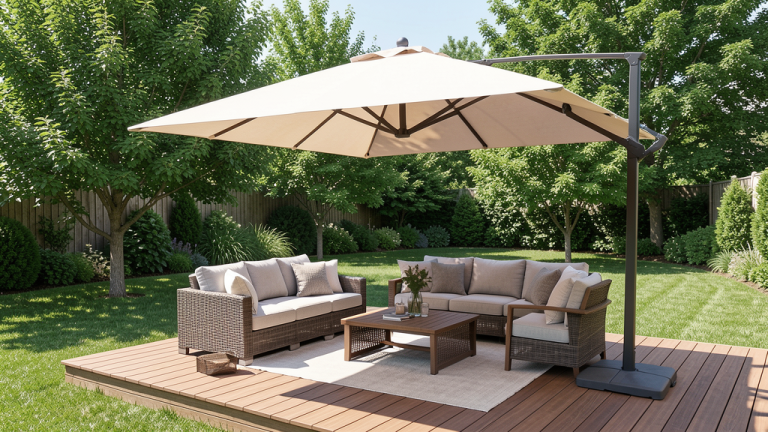
A single 12′ x 12′ shade sail covers most apartment balconies and small patios adequately. For under $150 you get real UV protection and some visual privacy, and you don’t need anyone’s permission to install it. If your budget stretches to $500, consider a small freestanding umbrella with a weighted base alongside the sail for layered coverage.
We have a full breakdown of small backyard ideas for tight spaces that covers exactly this situation — budget options that punch well above their price point.
Scenario 5: HOA-Heavy Neighborhood
Call your HOA before buying anything. Most HOAs allow retractable awnings without approval because they’re considered “temporary” when retracted. Shade sails vary — some HOAs love them, some hate them. Pergolas almost always require HOA architectural review, and some HOAs prohibit them outright.
If your HOA is restrictive, a motorized retractable awning is usually the highest-quality shade solution you can install without approval. When it’s retracted, it essentially disappears into the wall.
Combining Options: When More Than One Makes Sense
These three options aren’t mutually exclusive. A common setup that works extremely well:
- Pergola + shade sail: Build a pergola for the structure, then tension a UV-blocking shade cloth or sail across the top opening for rain/sun coverage without a permanent roof. This preserves the open feel while adding function.
- Pergola + retractable awning: Less common but works well for large patios where the awning covers one zone and the pergola covers another, each independently controlled.
- Shade sail + side curtains: Multiple sails at different angles with outdoor curtains on the sides create a near-room effect at a fraction of pergola cost.
Installation Considerations
Shade Sail Installation
The key is proper tensioning at all three (or four) corners. Slack shade sails look terrible, collect water, and fail faster. Use 3/16″ wire rope rather than the included rope ties on most kits — wire rope maintains tension through temperature cycling without stretching. Install your anchors at 10–15° above horizontal for best tension geometry.
Pergola Installation
For freestanding pergolas on concrete or pavers, surface-mount post bases (like Simpson Strong-Tie AB series) eliminate the need for footings. For soft ground, you’ll want 18–24″ concrete footings below your frost line to prevent heaving.
Attached pergolas require lag bolts into the ledger board (same principle as a deck). This is where permits come in — your connection to the house structure is what triggers the building department’s interest.
Retractable Awning Installation
Most residential awnings mount to a horizontal surface (fascia board) with four to six lag bolts. The key is locating the rafters behind your fascia — mount into wood, not just the fascia board itself, or the awning will pull off under load. For motorized awnings, run your electrical conduit during installation; surface-mounting conduit after the fact looks unprofessional.
Frequently Asked Questions
Which lasts longer — a shade sail or a retractable awning?
A quality retractable awning with solution-dyed acrylic fabric (like Sunbrella) lasts 10–20 years with minimal maintenance. Shade sails typically last 5–10 years depending on the HDPE density and how carefully you take them down in winter. If you’re storing a shade sail each fall and re-hanging each spring, it’ll last toward the top of that range.
Can I install any of these myself?
Shade sails: absolutely yes, any reasonably handy person can do it in a few hours. Pergola kits: yes, but plan a full weekend and have a helper — posts need to be perfectly plumb and square, and getting that right alone is difficult. Retractable awnings: yes for manual models, more challenging for motorized (running electrical is the tricky part).
What about wind resistance?
Pergolas handle wind best because they’re permanent structures. Shade sails should come down when sustained winds exceed 20–25 mph — the tension forces on the anchors multiply quickly and the fabric can tear. Retractable awnings should retract at 20–30 mph winds; motorized models with wind sensors handle this automatically.
Do shade sails provide rain protection?
No. Shade sails don’t shed water — they collect it in the center of the panel and eventually leak through or overflow the edges. For rain protection you need either a retractable awning (which has an angled pitch for runoff) or a pergola with a solid or louvered roof system. Some shade sails marketed as “waterproof” slow the water penetration but still collect standing water.
What’s the best option for a covered patio in a hot climate?
In hot climates like Texas, Arizona, or Florida, a louvered pergola gives you the best combination of UV blocking, airflow control, and durability. The adjustable louvers let you fully close against intense afternoon sun or open to let heat escape. Our guide to pergolas in Texas heat covers specific material and product recommendations for extreme-heat climates.
Is a pergola worth the investment if I’m selling in 5 years?
Generally yes, particularly aluminum or powder-coated steel models that require zero maintenance and photograph well. The key is keeping the style neutral — a simple rectangular pergola with clean lines appeals to a wide range of buyers. An over-customized or rustic-looking pergola can actually detract from value by looking like a maintenance burden to prospective buyers.
Can I add a ceiling fan to a shade sail or awning?
Not practically. Shade sails and awnings don’t provide a rigid overhead surface for mounting a fan. Pergolas do — a standard outdoor-rated ceiling fan with a downrod mounts directly to the pergola beam. This is one of the most impactful comfort upgrades you can add to a pergola, particularly in humid climates where moving air makes a significant difference.
Disclosure: This post contains affiliate links. If you purchase through these links, we may earn a small commission at no extra cost to you. We only recommend products we genuinely believe in.