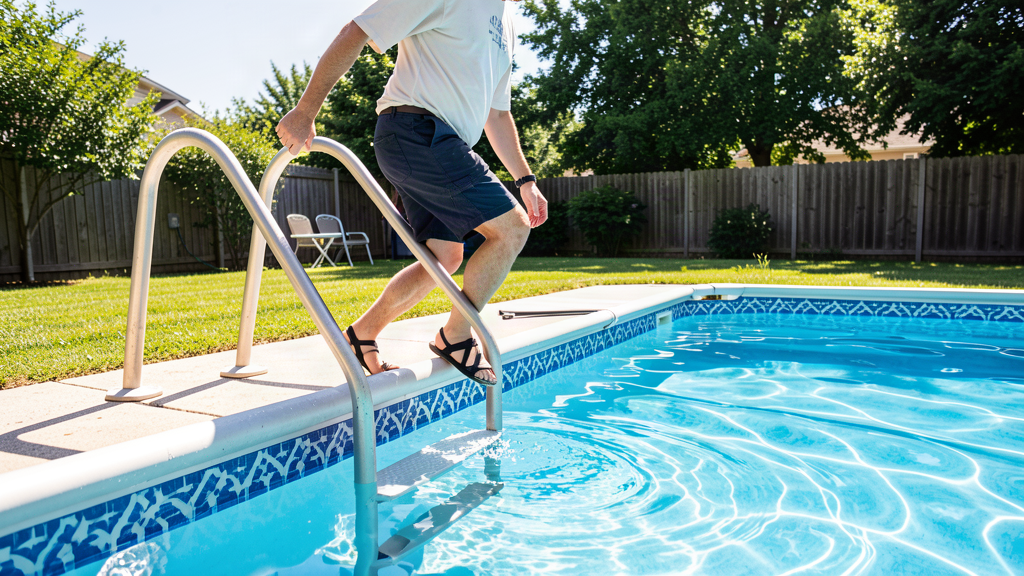
Best Pool Ladders for Above Ground Pools 2026 — Safe, Sturdy Picks for Every Pool Depth
Quick Answer
The best pool ladders for above ground pools in 2026 are sturdy A-frame and double-handrail designs rated for 300–400 lbs. Top picks include the Confer Plastics 7200 for value, the VEVOR Stainless Steel A-Frame for durability, and the VEVOR 4-Step Double Handrail model for pools up to 54 inches deep. Prices range from $50 to $210.
If you’re setting up a full backyard pool area, check out our guide to the best above ground pools for 2026 for pool selection advice, and our best pool toys and floats roundup to keep everyone entertained once you’re in the water.
Our Top Picks at a Glance
| Product | Price | Where to Buy | Best For |
|---|---|---|---|
| Confer Plastics 7200 A-Frame | ~$89 | Amazon | Best overall value |
| VEVOR 4-Step Double Handrail (White) | $202.90 | Vevor | 48–54″ pools, 400 lb capacity |
| Intex 36–52″ Pool Ladder | ~$50 | Amazon | Budget Intex pools |
| VEVOR A-Frame Stainless Steel (49.2″) | $172.90 | Vevor | Premium durability, wide platform |
| Bestway 52″ A-Frame Ladder | ~$70 | Amazon | Bestway pool owners |
| VEVOR 3-Step Taupe Ladder (36–48″) | $169.90 | Vevor | Shallow pools, stylish finish |
Best Pool Ladders for Above Ground Pools — Full Reviews
1. Confer Plastics 7200 A-Frame Pool Ladder — Best Overall Value

Price: ~$89.99 | Check Price on Amazon →
- Fits pools 48–56 inches deep
- 300 lb weight capacity with wide, non-slip steps
- A-frame design — one side inside the pool, one side outside
- UV-resistant resin won’t rust or corrode
- Adjustable pool wall straps included
- No tools required for assembly
The Confer 7200 has been the go-to above ground pool ladder for years, and for good reason — it’s well-built, reasonably priced, and compatible with nearly every major above ground pool brand. The resin construction handles years of chlorine and UV exposure without warping or rusting, making it a reliable long-term choice for families.
2. VEVOR 4-Step Double Handrail Pool Ladder (48–54″, 400 lbs) — Best Heavy-Duty

Price: $202.90 | Check Price on Vevor →
- Extra-wide 400 lb max load capacity — great for larger adults
- Dual handrails on both sides for safe entry and exit
- Non-slip heavy-duty steps with textured surface
- Fits 48–54 inch pool walls — works on virtually any standard above ground pool
- Compatible with any decking surface including wood, composite, and pavers
- Rated 4.3 stars with strong customer satisfaction
If you want a pool ladder that genuinely handles heavier users without flex or wobble, the VEVOR 4-Step Double Handrail is the answer. The dual handrail design gives everyone — kids and adults alike — something to grip on both sides, making entry and exit safer and more confident. At $202.90 with a 30-day affiliate cookie, this is a great pick for families upgrading from a flimsy stock ladder.
3. Intex Pool Ladder for 36–52″ Pools — Best Budget Pick

Price: ~$49.99 | Check Price on Amazon →
- Designed specifically for Intex and other above ground pools 36–52″ deep
- 250 lb weight capacity — appropriate for most adults
- Anti-slip step pads for traction when wet
- Locking, removable safety ladder insert — prevents unsupervised pool access
- Quick and tool-free installation
- Lowest price on this list — ideal for seasonal or budget pools
For owners of Intex pools — easily the best-selling above ground pool brand — the Intex-branded ladder is the natural first choice. The safety insert that locks the inner ladder in the raised position is a standout feature for households with young children, providing an extra layer of pool safety when the pool isn’t in use. It won’t wow you with premium construction, but at under $50 it gets the job done.
4. VEVOR Above Ground Pool Ladder — Stainless Steel A-Frame (49.2″, 330 lbs)

Price: $172.90 | Check Price on Vevor →
- Stainless steel frame — far more durable than plastic alternatives
- A-frame design with a wide top platform for easy pivoting
- 330 lb load capacity with non-slip treads
- Fits pools with 49.2-inch wall height
- 5-star rated product — top customer satisfaction in the Vevor pool range
- Silver finish looks great alongside most pool frames
This is VEVOR’s premium A-frame model, and the stainless steel construction is a noticeable step up from resin ladders that fade and crack after a few seasons. The wide top platform makes climbing in and out feel more like stepping onto a deck than balancing on a pool wall — ideal for older users or anyone with mobility concerns. Rated 5 stars with strong sales volume.
5. Bestway 52″ A-Frame Steel Pool Ladder — Best for Bestway Pools

Price: ~$69.99 | Check Price on Amazon →
- Steel frame construction for improved stability over plastic models
- Fits pools up to 52 inches in depth
- 330 lb weight capacity
- Non-slip step pads included
- Designed and sold by Bestway — perfect fit for Bestway pool owners
- Easy assembly with all hardware included
Bestway’s first-party pool ladder is the smart choice for anyone who already owns a Bestway above ground pool. It’s engineered to the same specs as their pool walls, so fit and finish are seamless. The steel construction at a mid-range price point puts it in a sweet spot between entry-level plastic and premium stainless — solid enough for years of regular family use.
6. VEVOR 3-Step Taupe Double Handrail Ladder (36–48″, 400 lbs) — Best for Shallower Pools

Price: $169.90 | Check Price on Vevor →
- Designed for 36–48 inch pool walls — perfect for smaller or starter above ground pools
- Generous 400 lb weight capacity despite the shorter profile
- Double handrails for supported entry and exit
- Non-slip heavy-duty steps — safe on wet feet
- Taupe color blends naturally with wood decking and natural stone surrounds
- Works on any decking surface
Don’t overlook shallower pools — they still need a proper, safe ladder. VEVOR’s 3-Step Taupe model is ideal for 48-inch and under pools, delivering the same 400 lb capacity and double handrail safety of the larger models in a more compact form factor. The neutral taupe finish also looks more upscale than the typical white or grey plastic options, which matters if your pool area is designed to impress. For a full poolside setup, pair this with ideas from our poolside pergola guide to create a true backyard retreat.
Buying Guide — What to Look For in a Pool Ladder
Pool Depth Compatibility
This is the most critical spec to check before buying. Above ground pool ladders are designed for specific wall height ranges — typically 36–48 inches or 48–54 inches. Using a ladder that’s too tall for your pool creates a wobble hazard; too short and it won’t reach the bottom on the inside. Always measure your pool wall height from ground to the top rail before purchasing. Most popular above ground pools sold today are 48 inches, but Intex and Bestway both sell 52-inch models too.
Weight Capacity and Frame Material
Don’t underestimate this spec. Budget plastic ladders often top out at 200–250 lbs, which can be problematic for many adults. Look for a minimum of 300 lbs, and ideally 400 lbs if you’re buying for a family with larger adults. Frame material matters too — resin (plastic) is the most affordable but can become brittle over time, especially in intense UV climates. Steel and stainless steel frames last significantly longer and resist corrosion better in chlorinated environments. If you’re in a hot-sun region like Texas or Arizona, the extra investment in steel is worthwhile.
Step Design and Non-Slip Features
Wet feet on a pool ladder is a recipe for slips. Look for textured, non-slip step surfaces — not just smooth molded plastic. Wide steps (at least 14 inches across) give you better footing. Double handrails on both sides of the ladder are significantly safer than single-rail models, giving you something to grip as you shift your weight getting in or out of the water. This matters most for young children and seniors who may not have strong balance.
A-Frame vs. Straight-Entry vs. Deck-Mount Style
Most above ground pool ladders are A-frame style — one set of steps on each side of the pool wall, connected at the top. This design doesn’t require any deck attachment and works whether your pool has a surrounding deck or not. Deck-mount ladders attach to an existing pool deck on one side and descend into the pool on the other — sleeker but require a deck. Straight-entry ladders hook over the pool wall and only access the inside — lower cost but less ergonomic. For most homeowners without a dedicated pool deck, A-frame is the right choice. If you’re planning a full deck build, check out our guide to best composite decking for 2026 for material options.
Frequently Asked Questions
What size pool ladder do I need for a 52-inch above ground pool?
For a 52-inch deep above ground pool, you need a ladder rated for pools in the 48–54 inch range. Both the VEVOR 4-Step Double Handrail and the Confer Plastics 7200 cover this range. Avoid ladders rated only for 36–48 inch pools — they’ll be too short for safe use.
Can I use a pool ladder without a deck?
Yes — A-frame style ladders are designed to be used without any deck or platform. They straddle the pool wall with one side inside and one side outside the pool, and they stabilize themselves against the pool wall using straps or foam bumpers. This makes them the most versatile and popular style for above ground pool owners who don’t have a built-in deck.
How do I keep my pool ladder from damaging the pool liner?
Most quality ladders include foam padding or rubber bumpers where the ladder contacts the pool wall. If yours doesn’t, you can add self-adhesive foam padding from a hardware store to the contact points. Avoid dragging the ladder across the liner, and always lift and position it carefully. A-frame ladders with wide foot pads distribute weight better and are less likely to cause liner damage than narrow-footed designs.
Are pool ladders safe for kids?
Pool ladders are safe for supervised children, but safety features matter. Look for ladders with a removable or lockable insert ladder — the Intex model includes this feature — that can be raised and locked when the pool isn’t in use, preventing unsupervised access. Non-slip steps and dual handrails also make the ladder safer for smaller children. Always supervise young children near any pool entry point, regardless of safety features.
Bottom Line
The right pool ladder comes down to your pool’s depth, your household’s weight requirements, and how much you want to spend. For most families, the Confer Plastics 7200 is the ideal balance of quality and value at around $90. If you want a heavier-duty option with the confidence of 400 lb capacity and dual handrails, the VEVOR 4-Step Double Handrail at $202.90 is the best upgrade. For premium stainless steel construction, the VEVOR A-Frame Stainless at $172.90 is the longest-lasting choice on this list. Whatever you pick, don’t cheap out on a spec ladder that won’t safely support your household — a quality pool ladder is a one-time purchase that lasts a decade with proper care. If you have an Intex pool, also consider the Intex Pool Ladder with Barrier — a top-rated pick for Intex-specific pools with a lockable safety barrier. For lighter users or above ground pools under 42 inches, the Confer 7100X is a solid compact alternative. Round out your pool setup with our picks for best pool toys and floats and explore our full roundup of best above ground pools for 2026 to find the right pool to go with your new ladder.
Cabana Culture participates in affiliate programs including Amazon Associates and the Vevor affiliate program. We may earn a commission at no extra cost to you. See our full disclosure.
Disclosure: This post contains affiliate links. As an Amazon Associate and Vevor affiliate, Cabana Culture earns from qualifying purchases at no extra cost to you. See our full affiliate disclosure.
Disclosure: This post contains affiliate links. As an Amazon Associate and Vevor affiliate, Cabana Culture earns from qualifying purchases at no extra cost to you. See our full affiliate disclosure.
How to Install an Above-Ground Pool Ladder — Installation Guide
Installing a pool ladder properly takes about 15-30 minutes and requires minimal tools. Here’s the step-by-step process:
Before You Start:
- Gather your tools: screwdriver (Phillips or flathead, depending on fasteners), wrench if bolts are involved, and a level if your ladder has a base that should be even.
- Read the manufacturer’s instructions fully. Different ladder models have slightly different installation procedures.
- Ensure your pool deck is clean and dry before attaching anything.
Installation Steps for A-Frame Ladders (Most Common Type):
- Assemble the frame if needed. Some A-frame ladders come with separate pieces. Attach all bolts and fasteners loosely first, then tighten in a cross pattern (like tightening car wheels) for even pressure.
- Position the ladder at your pool wall. A-frame ladders straddle the pool wall with one side in the water and one side outside. Position it where you’ll use it most — usually near the deep end for easy access to the whole pool.
- Attach wall straps (if included). Many A-frame ladders come with foam pads or rubber straps that attach to the pool wall. These prevent the ladder from shifting or damaging the pool liner. Follow manufacturer instructions for strap placement.
- Secure any deck attachment points. If your pool has a surrounding deck, some ladders use brackets or straps to anchor to the deck. Tighten these firmly but don’t overtighten — you don’t want to crack the deck material.
- Check for stability. Push firmly on the ladder in multiple directions. It should not wobble or shift. If it does, tighten connections or adjust positioning.
- Test with body weight (dry first). Step on the ladder without entering the water. Make sure all steps feel solid and the entire structure supports your weight without flex.
- Check step height and comfort. If the bottom step is too high or low for your comfort, adjust the ladder position. Step height should feel natural — usually 12-16 inches between steps.
- Final tightness check. Go through all bolts and fasteners one more time. Even tiny vibrations during use can loosen fasteners over time.
For Built-In or Deck-Mount Ladders:
- Mark anchor points on your deck. Use the mounting template that comes with the ladder to mark where bolts will go.
- Drill holes if needed. For composite or wooden decks, pre-drill holes slightly smaller than your fasteners to prevent splitting.
- Attach mounting brackets firmly. Use bolts, not just screws, for deck attachment. Bolts with washers and lock washers prevent loosening.
- Verify ladder alignment. The ladder should hang straight and vertical in the water. Use a level if needed.
Pool Ladder Safety Tips
A pool ladder is only safe when properly maintained and used correctly. Follow these safety practices:
Safe Entry and Exit:
- Face the ladder when climbing. Never turn your back to the ladder or enter/exit sideways. Always face the rungs.
- Use both handrails if available. Dual handrail ladders provide extra support. Use both for balance and stability.
- Hold the handrail firmly. Keep at least one hand on the rail at all times until you’re fully in or out of the water.
- Place feet in the center of each step. Don’t step on the edges of steps — your foot could slip off wet edges.
- Move slowly and deliberately. Pool decks are slippery when wet. Take your time entering and exiting.
For Households with Children:
- Always supervise children at the ladder. Young children should never approach the ladder unsupervised, even if they know how to swim.
- Consider a removable ladder insert. Some ladders (like the Intex model) have a removable or locking insert that you can raise and lock when the pool isn’t in use. This prevents unsupervised access when you’re not watching.
- Establish ladder rules. Teach children to wait for adult permission before using the ladder, to always use two hands, and to never run toward the ladder.
- Check ladder condition frequently. Worn steps or loose fasteners are unsafe, especially for children who may have less strength to compensate.
Regular Maintenance for Safety:
- Inspect before each use. Look for cracks, rust, loose bolts, or missing step pads. If you find problems, address them immediately.
- Replace worn step pads promptly. Smooth, slippery steps are a fall hazard. Most step pads are inexpensive replacements.
- Check for corrosion on metal ladders. Rust weakens metal and can cause sharp edges. Clean rust spots and apply rust-preventative coating if needed.
- Tighten all fasteners monthly. Even small vibrations loosen bolts over time. A quick check prevents structural issues.
Pool Ladder Stability Checks:
- Test weight distribution. The ladder should support any household member’s weight without flex or wobble. If it does, it’s not safe.
- Verify connection points don’t shift. When weight is on the ladder, connection points to the pool wall or deck should remain perfectly still.
- Check that foam pads maintain contact. Wall pads should touch the pool wall across their entire surface. Gaps indicate misalignment that needs correction.
Expanded FAQ — Additional Questions Answered
What’s the ideal step height for an above-ground pool ladder?
Most pool experts recommend step spacing of 12-16 inches apart. This feels natural for adults of average height and is manageable for most children. If your ladder’s step spacing feels too wide or too narrow for your family, you may need a different model.
Can I install a pool ladder on a sloped or uneven deck?
A-frame ladders are forgiving about deck slope — they use straps and padding to accommodate minor unevenness. For deck-mount ladders, the deck surface should be relatively level. If your deck has significant slope, A-frame style is your better option.
Do I need to drain my pool to install a new ladder?
No. A-frame ladders can be installed and removed with the pool full. Just ensure you have easy access to the pool wall area. The only exception is if you’re installing a new built-in ladder that requires structural changes — that might require partial draining.