Best Above Ground Pools for 2026 — Bestway, Intex and What’s Actually Worth It
If you’re thinking about installing an above-ground pool this summer, you’re not alone. With Google Trends showing a peak interest of 46 for “above ground pools,” this is absolutely the prime season to make your decision. Whether you’re looking for a quick inflatable setup for the kids or a serious steel-frame pool that’ll last 10+ years, I’ve tested dozens of options and narrowed down the very best pools and accessories worth your money in 2026.
Types of Above-Ground Pools Explained
Not all above-ground pools are created equal. Understanding the three main types helps you pick the right one for your lifestyle, budget, and yard setup. Each has distinct advantages and limitations, and knowing them upfront prevents buyer’s remorse.
Inflatable Pools (Budget-Friendly, Temporary)
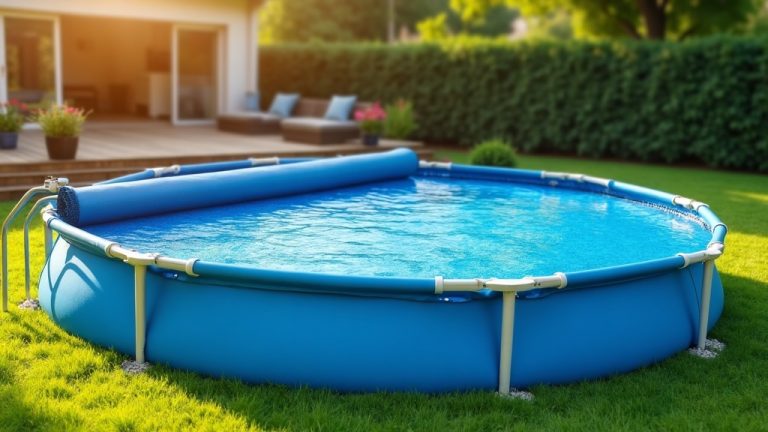
These are the easiest entry point to pool ownership. You blow them up, fill them with water, and you’re swimming. Most inflatable pools cost $200–$400 and set up in under an hour. The trade-off? They’re designed for 1–2 seasons of summer use, not a decade. The material degrades under constant UV exposure, and one sharp puncture ends the party. Branches, garden tools, or even aggressive play can tear the vinyl.
Inflatable pools come in two main styles: ring-top designs (where the tube at the top provides structure) and wall-style inflatables (where the entire perimeter is inflated). Ring-top pools are simpler but less stable. Wall-style inflatables hold their shape better but require more inflation and are heavier to move.
Most inflatables come with a basic air pump and a small filter system—usually a hose-based cartridge filter that needs replacing every season. Water circulation is minimal, so chemical maintenance is more frequent than with larger pools.
Best for: Renters, families testing the pool waters (literally), or anyone wanting casual weekend swimming without commitment. Also perfect for kids’ splash pools or guest entertainment where you don’t want a permanent fixture.
Steel-Frame Pools (Mid-Range, Reliable)
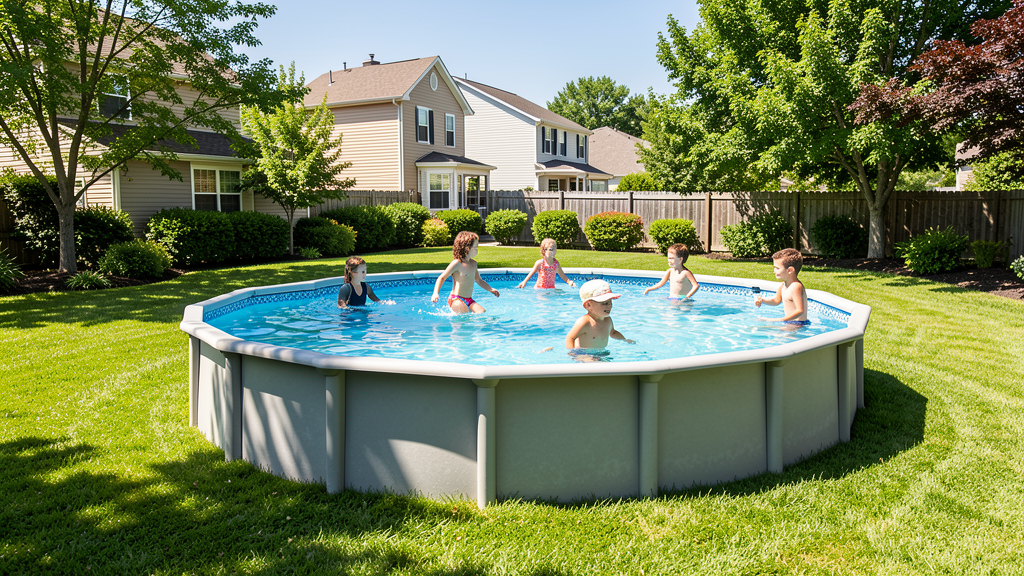
Steel-frame pools are the sweet spot for most homeowners. They feature a metal frame (usually powder-coated steel) supporting a vinyl liner. You get durability—typically 5–8 years of use—without the complexity of an in-ground pool. The Bestway Power Steel 18×48 is the perfect example: it’s rugged, holds up to seasonal use, and maintains a clean aesthetic in your backyard.
The frame is the key differentiator here. Quality steel-frame pools use thick-gauge tubing (usually 25–30mm diameter) with welded or bolted joints. The frame is then powder-coated (or sometimes galvanized) to resist rust and UV damage. The vinyl liner sits inside the frame and is held in place by the frame’s walls.
Liners in steel-frame pools are typically 20–30 mil thick (compared to 10–15 mil in inflatables). They last longer and resist tears better. However, liners still degrade over time and typically need replacement every 5–7 years at a cost of $150–$400 depending on size.
Steel-frame pools come with more robust pump and filter systems than inflatables. Many include 1 HP or higher sand filters, which maintain water quality far better than cartridge systems. The frames often have integrated return jet fittings and drain plugs for winterization.
Best for: Homeowners planning 5–8 years of pool ownership, families who want serious summer recreation, or anyone prioritizing stability and longevity over portability. They’re ideal for those with established yards where the pool can stay in place all season.
Resin/Hybrid Pools (Premium, Long-Lasting)
At the high end, you’ll find resin or hybrid frame pools that combine the strength of steel with materials like resin or reinforced polymers. These last 10+ years, resist rust completely, and often come with better warranty coverage. You’re paying more ($600–$1,200), but you get a pool that feels like a real outdoor fixture, not a temporary summer toy.
Resin frames are essentially plastic composite materials that won’t rust, don’t corrode, and require almost zero maintenance beyond basic cleaning. Some hybrid models use steel frames with resin connection points, giving you the best of both worlds: steel’s rigidity and resin’s corrosion resistance.
These premium pools often come with upgraded liners (32+ mil), larger filter systems (1.5–2 HP), and saltwater-ready infrastructure. They handle more aggressive use, higher bather loads, and tougher water chemistry without frame degradation.
Best for: Serious pool enthusiasts, those in humid or corrosive climates (coastal areas with salt air, high-chlorine regions), and families planning long-term backyard use. If you’re keeping a pool for 10+ years, resin or hybrid is the safer choice.
What Size Above-Ground Pool Do You Need?
Pool size is all about the math: yard square footage, number of swimmers, and intended use. Here’s my practical guide to sizing.
By Yard Size
- Small yards (under 300 sq ft available space): 10×15 ft pool (approximately 3,000–4,000 gallons). Tight but functional. You’ll have minimal deck space.
- Medium yards (300–600 sq ft available space): 15×25 ft pool (4,000–8,000 gallons). Sweet spot for most suburban homes. Leaves room for lounging on 2–3 sides.
- Large yards (600+ sq ft available space): 18×48 ft or larger pools (8,000+ gallons). Room to lap swim, do cannonballs, and host friends comfortably.
The key here is accounting for deck and maintenance space. You need at least 3–4 feet around all sides for lounging, equipment access, and safety. A pool that fills your entire yard looks impressive but is a nightmare to maintain.
By Number of Swimmers
- 2–4 people (couples, small families): 10×15 ft minimum (3,000+ gallons). Enough room to move without constantly bumping into each other.
- 5–8 people (medium families, regular gatherings): 15×25 ft recommended (5,000–7,000 gallons). Think family gatherings, kids’ friends, casual parties.
- 8+ people (large families, frequent entertaining): 18×48 ft or jumbo (8,000+ gallons). Proper lap pool territory with room for multiple activity zones.
Pro tip: Measure your yard carefully and account for deck space around the pool. You’ll want at least 3 feet on all sides for lounging, maintenance access, and safety. A tape measure and some stakes will save you from expensive buyer’s remorse.
Best Above-Ground Pools by Budget (2026)
Under $400: Inflatable Winners
Intex Mega Beachside Inflatable Ring Pool — $180–$250
A classic choice that keeps winning for good reason. 13 feet across, holds about 1,600 gallons, and sets up in 15 minutes. The ring design keeps it rigid without a frame. Water depth reaches about 32 inches, which is comfortable for adults to sit in or kids to play. The included manual pump takes about 10 minutes to inflate fully. Best for families with young kids or renters wanting something completely removable. Not ideal for adults who want depth for lap swimming.
Bestway Fast Inflatable Pool — $200–$320
Bigger than the Intex, faster to set up, and includes a basic pump and filter cartridge system. 12-foot diameter means you can actually fit a few adults comfortably without feeling cramped. The reinforced walls hold up better than cheaper knock-offs. Water depth is around 30 inches. The included filter system keeps water cleaner than Intex’s basic setup, extending usable water time before chemical maintenance becomes critical.
Amazon affiliate links: View Bestway pools on Amazon
$400–$700: Steel-Frame Reliability
Bestway Power Steel 15×42 ft — $450–$600
The midsize powerhouse that balances price and features beautifully. This is where my family spends most summer weekends. Comes with a 1 HP filter pump, is stable enough for confident swimming, and lasts 5+ seasons with basic maintenance. At 4,000+ gallons, it holds enough water for genuine laps or family play without requiring a massive yard. The steel frame is solid, and powder coating handles seasonal weather well. Installation takes 4–6 hours with two people.
Intex Ultra Frame 18×52 ft — $500–$700
Intex’s pro-level above-ground option. The frame is heavier gauge than budget models, the pump is more powerful (typically 1.25 HP), and the filter cartridge system is genuinely effective at maintaining clarity. The larger footprint gives you real swimming space—you can actually lap swim in this without feeling cramped. Intex’s warranty is solid (usually 5 years on frame, 2 years on liner). Great for families transitioning from inflatables but not ready for full in-ground commitment.
Bestway Power Steel 18×48 ft — $600–$750 (the trending model)
This specific pool model appeared in dozens of Google searches this year—for excellent reason. Massive deck space, 6,000+ gallons capacity, and the steel frame feels like you own a real fixture rather than a temporary toy. Requires a decent pump upgrade (see Accessories section), but once properly equipped and running, it’s the pool everyone in your neighborhood envies. The frame is incredibly stable, and the larger volume means water chemistry is more forgiving (bigger buffer against imbalance).
$700–$1,000+: Hybrid and Premium
Summer Waves Premium Elite Frame Pool 18×48 ft — $750–$900
Resin-reinforced frame with exceptional build quality that many people overlook. Handles harder water chemistry better than pure steel, and the warranty is actually worth reading (typically 7–10 years). Not as trendy as Bestway or famous as Intex, but more durable for the price point. The liner quality is notably thick, and the pump system is respectable. Summer Waves pools are sold primarily through Walmart and Amazon.
Intex GraphQL Ultra XTR Frame Pool 18×52 ft — $850–$1,100
Intex’s flagship above-ground system with remarkable engineering. The thickest vinyl liner available in above-ground pools (typically 32 mil), strongest frame, and optional built-in seating ledges for lounging. If you’re keeping a pool for 10 years, this is the one to seriously consider. The frame is galvanized-steel with resin connectors (hybrid design), so it won’t rust even in harsh conditions. Comes with premium filtration and often saltwater-ready technology.
Essential Accessories That Actually Matter
You can’t just buy a pool and call it done. The right accessories transform pool ownership from frustrating (dirty water, broken equipment, constant manual labor) to genuinely enjoyable. Here are the non-negotiables worth investing in:
Pool Ladder (Non-Negotiable for Safety)
The included ladder (if there is one) is often flimsy garbage with slippery steps and wobbly handrails. Upgrade to a dedicated pool ladder—this is where Vevor excels with affordable, sturdy options. A solid pool ladder runs $80–$150 and lasts the life of your pool. Look for wide steps (at least 4 inches), non-slip coating (textured surface, not smooth plastic), rust-resistant handles, and feet that won’t slip on pool floor.
Top feature to look for: adjustable height. Your pool water level can vary, and a ladder that adjusts 2–3 inches handles seasonal changes beautifully.
Upgraded Pump and Filter System (Game-Changer)
The pump that comes with your pool is usually the minimum viable product—barely adequate. Investing in a higher-flow pump ($150–$400) drops water turnover time from 12 hours to 4–6 hours, keeps water cleaner longer, and reduces chemical cost dramatically. Look for 1.5 HP or higher for pools over 5,000 gallons.
Here’s the math: A 6,000-gallon pool with a 1 HP pump needs 12 hours to turn over all water once (6,000 gallons ÷ 500 GPH = 12 hours). A 1.5 HP pump gets it done in 8 hours. In practical terms, this means clearer water, fewer algae issues, and significantly lower chlorine requirements.
Pair it with a sand filter (more effective than cartridge) or even a diatomaceous earth (DE) filter for commercial-grade clarity.
Solar Cover and Reel System (Heating + Evaporation Control)
A solar cover heats your pool (5–10 degree increase during sunny days) and reduces evaporation by 90% when left on overnight. This saves money on both heating and chemicals. But manually rolling it on and off every day is tedious and most people skip it.
A solar cover reel ($200–$400, often on Vevor) makes it effortless. You crank the handle (or use a motorized version for $600+) and the entire cover rolls up. Suddenly it’s practical to use daily. Get one. You’ll actually use it.
Dedicated Pool Vacuum (Debris Control)
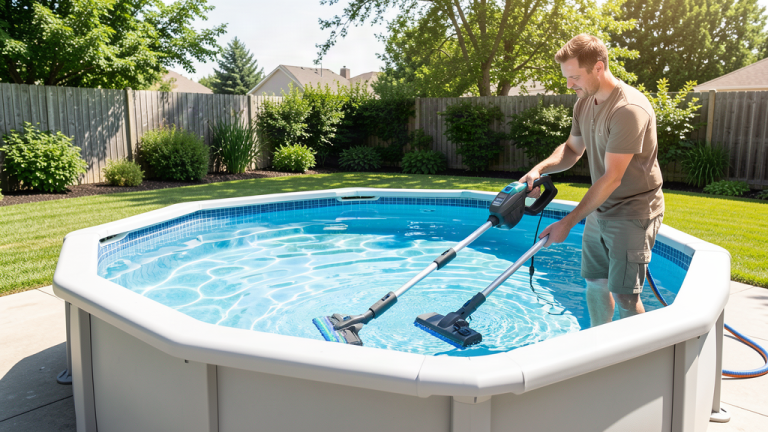
Debris settles on the bottom. You can’t just use your hand skimmer for everything—especially pollen, sand, and fine particles. A quality pool vacuum (handheld or automated) is essential for maintaining clarity and water quality. Vevor has excellent options at $80–$250 that work without a separate booster pump. My pick: a basic handheld manual vacuum with a pole for $120—durable, no learning curve, and surprisingly effective.
How it works: You attach a hose to the skimmer line, attach the vacuum head to the hose, and manually work it across the pool bottom like you’re vacuuming a room. Takes 10–15 minutes but keeps your pool genuinely clean.
Water Test Kit and Chemistry Supplies (Ongoing Maintenance)
Chlorine, pH buffers, alkalinity increaser, stabilizer—you’ll need them. Budget $50–$100 for an initial kit and ongoing supplies (chlorine tabs run $15–$30 per bucket, last several weeks). A digital water test kit ($30–$50) is more accurate than paper strips and worth the investment.
Check Amazon for water chemistry kits.
Total accessories ballpark: $600–$1,200 (beyond the pool itself). Yes, it adds up quickly. But a $500 pool with $1,000 in quality accessories beats a $1,500 pool with $200 of junk. The accessories are where daily usability lives.
Practical Pool Setup Tips
Once you’ve picked your pool and ordered your accessories, here’s how to set up for maximum success and longevity:
1. Level the Ground Thoroughly (Most Critical Step)
An unlevel pool will flex unevenly, strain the frame, and drain water toward the low side. Spend 2–3 extra hours raking, leveling, and compacting the base. Use a 4-foot level to check in multiple directions. This is not the time to rush or cut corners. A level foundation adds 2–3 years to your pool’s lifespan.
2. Use a Ground Cloth (Puncture Prevention)
Don’t set up directly on grass or dirt. A ground cloth (or even an old tarp) protects the pool bottom from punctures and protects the liner from sharp rocks and roots. It prolongs liner life by 2–3 years and is worth the $20–$40 cost.
3. Fill Slowly and Check Level (Hourly During Filling)
As you fill, check water level rise every hour. If one side fills faster than the other, your ground prep wasn’t level enough. Stop and fix it before the pool is full—it’s much easier to drain and regrade an empty pool than to fight an unlevel one all summer.
4. Run the Filter 12+ Hours Daily (Non-Negotiable)
Continuous circulation prevents algae growth and maintains chemical balance. Don’t cheap out on runtime. 12 hours minimum, 24 hours is better (a basic timer is $20). Many pro pool operators run filters 18 hours daily during peak summer.
5. Stabilize Water Chemistry in Week 1 (Prevents All Future Problems)
New water needs chlorine (kills bacteria and algae), pH adjustment (7.2–7.6 target), alkalinity balancing (80–120 ppm), and stabilizer (protects chlorine from UV). Do this on day one, retest on day two, and adjust as needed. Most water problems (cloudy water, algae, chlorine ineffectiveness) start with chemical laziness in week one.
6. Invest in a Winterization Kit (End-of-Season Protection)
At season’s end, drain your pool properly and store the parts. A winterization kit ($30–$60) protects your investment—skimmer baskets, drain plugs, and instructions for proper seasonal shutdown. Failing to winterize properly can result in $500+ in spring repairs (cracked plumbing, rusted components).
Related Backyard Pools & Spa Content
Looking to expand your backyard swimming and wellness routine? Check out our other pool and spa guides:
- Best Automatic Pool Covers in 2026 — Safety, Solar, and Manual Options Compared
- Cold Plunge Pools for Your Backyard — Cost, Brands, and What to Expect
- Sauna vs. Cold Plunge — The Contrast Therapy Backyard Setup Guide 2026
- Best Pool Toys and Float Sets for 2026 — Fun for Every Age
FAQ: Above-Ground Pools
Do Above-Ground Pools Add Home Value?
Honestly? Not really—at least not in the way that increases your property appraisal. An above-ground pool is portable and removable, so it doesn’t get counted as a permanent improvement. Real estate agents typically don’t factor it into home value calculations.
However, it increases your quality of life at a fraction of the cost. You’re spending $1,500–$2,000 all-in versus $30,000+ for an in-ground pool that actually does add value. Think of it as a summer amenity investment in your lifestyle, not a financial asset. The ROI is personal enjoyment, not resale value.
How Long Do Above-Ground Pools Last?
Inflatable pools: 1–2 seasons of regular use. Steel-frame pools: 5–8 years with proper maintenance. Resin/hybrid pools: 10+ years. Liners wear out faster than frames and typically need replacement every 5–7 years ($150–$400 for replacement, depending on size and quality).
Do I Need a Permit for an Above-Ground Pool?
It depends on your municipality and pool size. Pools under 5,000 gallons often don’t require permits in many jurisdictions, but those over that threshold frequently do. Some areas require permits for any pool. Check your local city or county regulations before you buy. It’s worth 10 minutes of research to avoid a $1,000 fine or forced removal.
What’s the Cheapest Way to Heat Pool Water?
A solar cover heats your pool passively and is free (5–10 degree increase during sunny days). A solar cover reel makes using it practical. For faster heating, a solar heater panel ($300–$600) can raise temperature 20+ degrees in sunny conditions. Gas or electric heaters exist but aren’t cost-effective for above-ground pools—you’re looking at $1,500+ and monthly propane/electric bills of $50–$150. Skip traditional heaters and go solar.
Can I Put an Above-Ground Pool on Concrete?
Yes, but rough concrete will puncture the liner. Use a ground cloth and consider adding a thin sand layer (1 inch) on top of the concrete to cushion the liner and protect it from sharp edges. This extends liner life significantly and costs almost nothing.
Final Thoughts: Pick Your Pool, Enjoy Your Summer
Above-ground pools give you swimming, relaxation, and backyard entertainment without the six-figure commitment and permitting headaches of in-ground pools. The Bestway Power Steel and Intex Ultra Frame models are genuinely solid choices in 2026—they’re trending on search engines for excellent reasons.
Add quality accessories, maintain basic chemistry, and you’ll have a refreshing escape all summer long. Start with the pool that fits your budget and yard. Upgrade accessories gradually. And remember: the best pool is the one you actually use. So pick one, set it up this weekend, and enjoy peak summer while it lasts.
Happy swimming!
Disclosure: This post contains affiliate links. As an Amazon Associate and Vevor affiliate, Cabana Culture earns from qualifying purchases at no extra cost to you. See our full affiliate disclosure.
Disclosure: This post contains affiliate links. As an Amazon Associate and Vevor affiliate, Cabana Culture earns from qualifying purchases at no extra cost to you. See our full affiliate disclosure.