Best Smart Outdoor Lighting Systems for 2026 — App-Controlled & Solar
Best Smart Outdoor Lighting Systems for 2026 — App-Controlled & Solar
Smart outdoor lighting has crossed a threshold in 2026: it’s no longer a luxury upgrade for tech enthusiasts — it’s a practical, affordable way to improve security, extend your outdoor living hours, and cut energy costs at the same time. App-controlled systems let you set schedules, adjust brightness, and change colors from your phone. Solar models eliminate wiring entirely. And the best systems tie into Alexa, Google Home, or Apple HomeKit so your patio lights can respond to voice commands or automate with your existing smart home setup. This guide covers the top smart outdoor lighting systems of 2026 — from starter kits under $100 to whole-yard systems that transform your property after dark.
affiliate link1. Govee Outdoor String Lights — Best Budget Smart Lighting
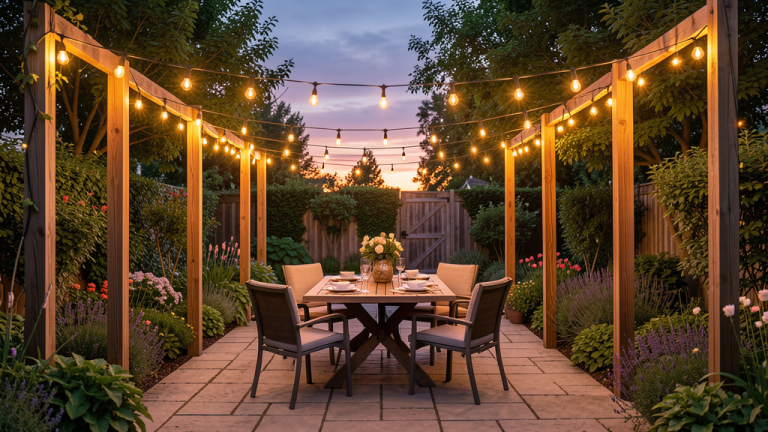
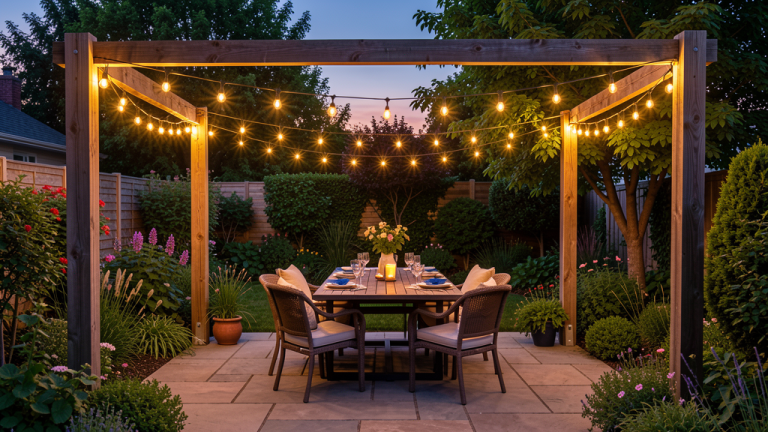
Govee has become the go-to brand for affordable smart lighting, and their outdoor string lights deliver surprisingly robust app control at a fraction of what Philips Hue costs. The lights support 16 million colors and dozens of dynamic effects, controlled via the Govee Home app (iOS and Android) with Alexa and Google Assistant compatibility. They’re IP65 weather-rated — enough to handle rain and humidity — and the shatterproof bulbs hold up through wind and the occasional bump. A 48-foot strand covers most standard patio configurations and the warm white and multicolor modes are genuinely useful for entertaining versus ambiance settings. At under $50, this is the easiest entry point into smart outdoor lighting with no hub required.
2. Philips Hue Outdoor Lily Spotlight — Best Premium App-Controlled Spotlights
Philips Hue remains the gold standard for smart lighting ecosystems, and the Outdoor Lily spotlight is their best yard-focused fixture. The Lily spotlights are IP67 waterproof — fully submersible — and deliver rich, accurate color rendering across the full spectrum. They integrate seamlessly into the Hue ecosystem, meaning you can sync them with indoor lights, automate sunrise/sunset routines, and control them through Alexa, Google, Siri, or the Hue app. The tradeoff: you need a Hue Bridge (sold separately, ~$60) and the fixtures themselves run $50–80 each. For a full landscape lighting setup — spotlights on trees, uplights on focal points, path lights along walkways — the total investment is significant but the ecosystem cohesion is unmatched. Nothing else integrates this reliably.
3. LITOM Solar Path Lights — Best Solar Smart Landscape Lights
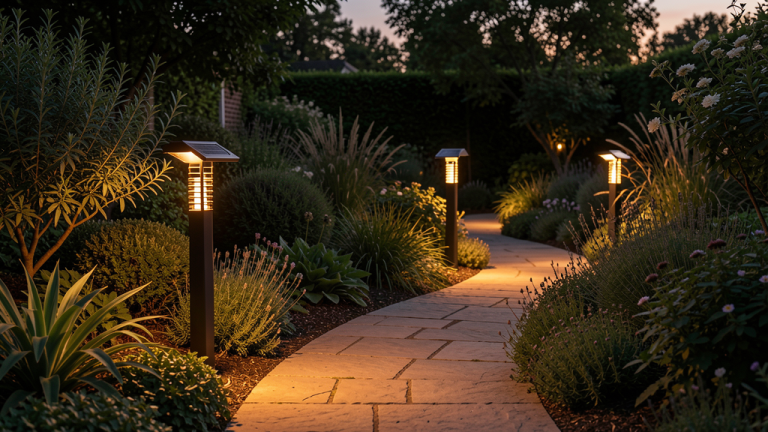
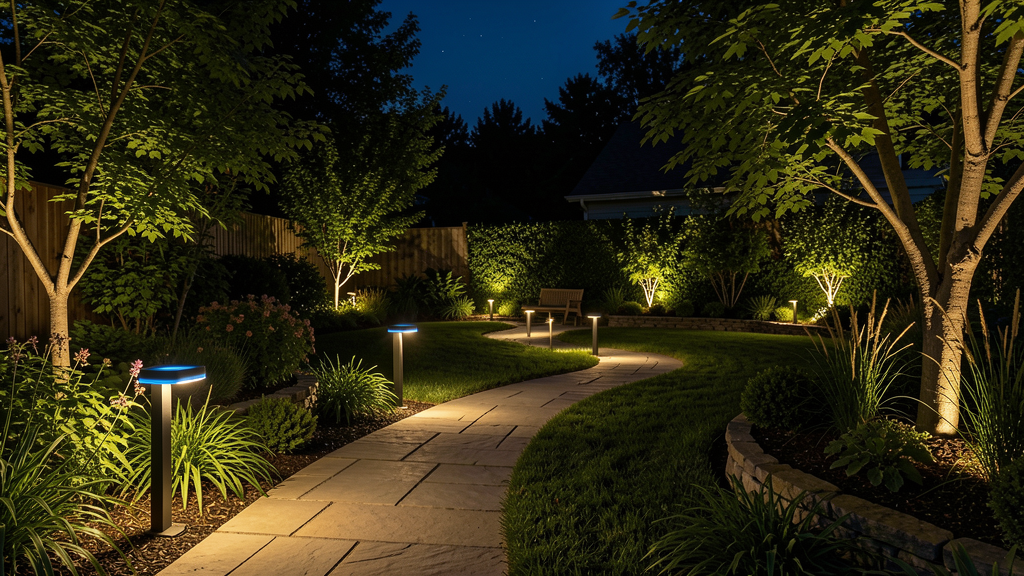
For path lighting, solar remains hard to beat for pure convenience — no wiring, no electricity costs, and installation that takes minutes. LITOM’s solar path lights are among the best value in 2026: each unit has a built-in motion sensor, automatic dusk-to-dawn activation, and an upgraded solar panel that charges efficiently even in partial shade. They’re not “smart” in the app-controlled sense, but they respond to real-world conditions automatically — brighter when motion is detected, dim ambient mode otherwise. A set of 12 covers a full garden path or driveway perimeter at a cost that’s hard to argue with. For purely decorative or safety-oriented path lighting without the smart home complexity, these are the practical choice.
4. Kasa Smart Outdoor Plug — Best Way to Make Any Light “Smart”
Before you replace all your outdoor fixtures, consider the Kasa Smart Outdoor Plug — a $20–30 device that adds Wi-Fi scheduling and app control to any existing outdoor light. Plug your string lights, landscape spotlights, or decorative lanterns into it and you instantly get on/off scheduling, voice control via Alexa or Google, and remote control from your phone. It’s IP64 weather-resistant, has two independently controllable outlets, and requires no hub. This is the best upgrade for homeowners who already have outdoor lighting they like and just want to automate it without a full system replacement. A single Kasa plug controlling a set of string lights and an uplighter is a weekend project that costs under $30.
5. Govee Permanent Outdoor Lights — Best Architectural Smart LED System
Govee’s Permanent Outdoor Lights are the closest thing the consumer market has to a professional architectural lighting system. The individual RGBIC LED pods mount permanently under your roofline or along fascia boards and are individually addressable — meaning each pod can display a different color simultaneously for wave effects, holiday themes, or solid accent illumination. The app control is genuinely impressive: dozens of preset animations, custom scene creation, music sync, and integration with Alexa and Google. These require hardwired power (typically a licensed electrician for roofline installation), but once installed they replace seasonal light strings entirely. One set handles Christmas reds and greens in December, Halloween orange in October, and warm white year-round ambiance the rest of the year.
6. Ring Smart Lighting — Best Security-Focused Smart Outdoor System
If security is your primary motivation for upgrading outdoor lighting, Ring’s Smart Lighting line integrates directly with Ring cameras and the Ring app to create a coordinated response: a motion sensor triggers the floodlight and sends a push notification, the camera starts recording, and you can view the live feed and two-way talk from your phone. The Ring Bridge ($30) connects everything over a dedicated Z-Wave mesh network — more reliable than Wi-Fi for security applications — and the battery-powered options eliminate wiring. For households already using Ring cameras, adding the smart lighting line is the most seamless upgrade possible. For households starting fresh, Ring is a solid security-forward choice even without existing cameras.
affiliate linkBuying Guide: Choosing the Right Smart Outdoor Lighting System
Determine your primary use case first. Smart outdoor lighting falls into four categories with different optimal solutions:
- Ambiance and entertaining: Govee or Philips Hue string lights and color-changing spotlights. Priority is color quality and app features.
- Security and deterrence: Ring or Kasa floodlights with motion sensors. Priority is camera integration and reliable triggering.
- Path and landscape: Solar-powered sensors (LITOM) for convenience, or low-voltage landscape kits for consistent output. Priority is reliability and coverage.
- Whole-home architectural: Govee Permanent Lights or professional systems. Priority is permanent installation and seasonal versatility.
Smart home ecosystem compatibility: If you’re invested in Alexa, buy from brands with strong Alexa skill support (Govee, Kasa, Ring). If you use Apple HomeKit, Philips Hue and Lutron Caséta are the most reliable. Google Home users have the broadest compatibility — most major brands work.
Wired vs. solar vs. battery: Solar is convenient but inconsistent in shaded yards or cloudy climates. Battery-powered lights offer flexibility but require maintenance. Wired systems are the most reliable but require installation planning. For decorative patio lighting, solar or wired string lights are ideal. For security lighting, wired or battery with solar backup is best.
IP rating matters: Look for IP65 minimum for most outdoor use (protected from rain jets). IP67 means submersible — important for ground-level fixtures, poolside use, or areas with standing water.
Lumens, not watts: For path lighting, 40–100 lumens per fixture is sufficient. For security floodlights, 700–1,500 lumens per fixture is the useful range. Color temperature: 2700–3000K is warm and welcoming; 4000–5000K is daylight-accurate and better for security applications.
Frequently Asked Questions
Do smart outdoor lights work without Wi-Fi?
Most smart lights require Wi-Fi for initial setup and remote access, but many retain basic functionality (on/off schedules already programmed) when Wi-Fi is unavailable. Philips Hue operates on its own Zigbee network via the Bridge, so it continues working locally even if your internet is down. Govee and Kasa require Wi-Fi for app control, but schedules set in the app execute independently once programmed.
Can I mix brands in a smart outdoor lighting setup?
Yes — with a shared voice assistant or smart home hub as the unifying layer. All major brands support Alexa and Google Home, so you can control Govee string lights, Kasa plugs, and Ring floodlights from the same app or voice commands even though they’re different brands. For tighter integration (automated scenes across multiple devices), keeping to one ecosystem (all Philips Hue, all Ring) produces more reliable results.
How much does a complete smart outdoor lighting setup cost?
A basic setup — smart string lights for the patio plus a smart plug for existing landscape lighting — runs $60–100 and can be done in an afternoon. A mid-tier setup with path lights, spotlights, and string lights from a cohesive ecosystem (Philips Hue or Govee) runs $200–500 depending on coverage area. A comprehensive whole-property system with permanent architectural lighting plus security floodlights runs $500–1,500+ depending on home size. Professional installation (for wired systems) adds $200–600 typically.
Are solar smart lights reliable enough for security use?
Solar lights are reliable for path lighting and decorative use, but for security applications — where you need consistent, bright illumination every night regardless of cloud cover — wired or battery-powered options are more dependable. A solar security light that didn’t charge fully on a cloudy day will be dim or off exactly when you might need it most. If solar is your only option, choose models with at least 2,000 mAh battery capacity and test them over a week of typical weather before relying on them for security.
Bottom Line
Smart outdoor lighting in 2026 offers genuinely impressive value — the gap between budget brands like Govee and premium brands like Philips Hue has narrowed considerably, and even entry-level systems deliver reliable app control, voice integration, and attractive light quality. Start with a smart plug if you already have outdoor fixtures you like. Upgrade to a dedicated smart system when you’re ready to add color, automation, and ecosystem integration. Add security-focused lighting wherever motion detection and camera integration matter. Done right, smart outdoor lighting transforms your yard’s usability after dark while actually reducing your energy consumption compared to leaving lights on manually.
Disclosure: This post contains affiliate links. As an Amazon Associate and Vevor affiliate, Cabana Culture earns from qualifying purchases at no extra cost to you. See our full affiliate disclosure.