Patio on a Budget Under $1,000 — Real Ideas That Actually Work
Patio on a Budget Under $1,000 — Real Ideas That Actually Work
You don’t need a contractor, a designer, or a second mortgage to build a backyard worth spending time in. Plenty of homeowners have created beautiful, functional outdoor spaces for under a thousand dollars — and not by cutting corners, but by spending smart. This guide breaks down exactly how to do it: the right furniture, the right upgrades, and the right sequence so every dollar does double duty. Whether you’re starting from bare concrete or breathing new life into a neglected deck, there’s a clear path to a patio you’ll actually use.
affiliate link1. Start with a Budget Outdoor Seating Set ($150–$350)
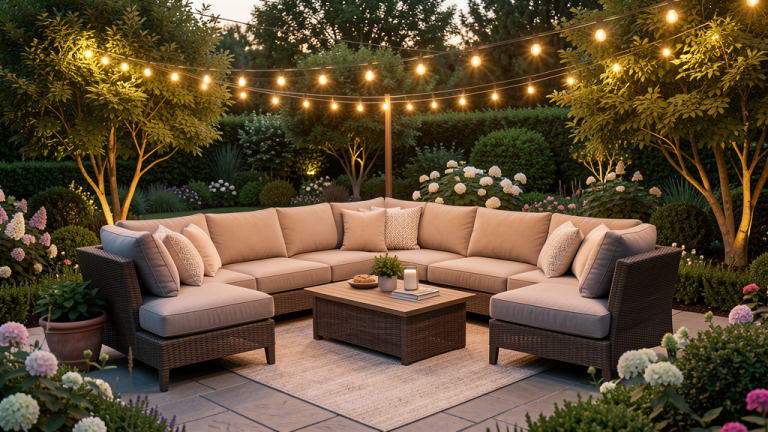
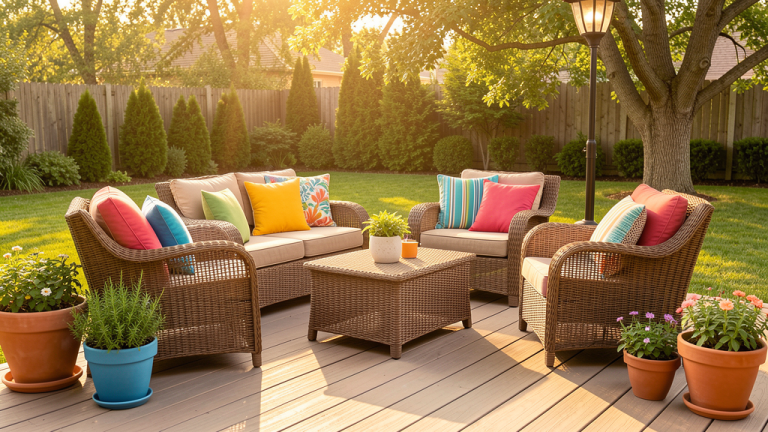
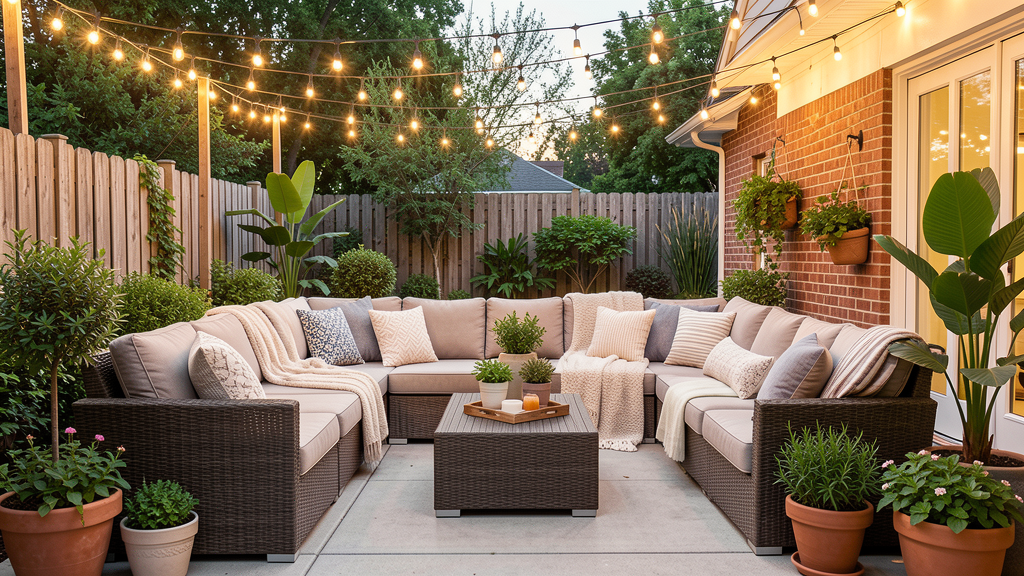
Seating is the foundation of any functional patio. For under $350, you can find surprisingly solid sets — especially in steel, resin wicker, or acacia wood — that hold up through full seasons with minimal care. Avoid sets with thin cushion foam and look for replaceable cushion covers, since that extends longevity without replacing the whole set.
A loveseat-plus-chairs configuration works well for most spaces, and folding chairs let you scale up for guests without crowding the area when they’re not there. Target, Walmart, and Amazon all carry budget-friendly sets that won’t look cheap in photos — or in person. Look for weight ratings above 250 lbs, UV-resistant fabric, and rust-resistant frames as your three non-negotiables.
Budget allocation: $180–$320 leaves room for upgrades in other categories without eating your whole budget up front.
Shop Budget Patio Sets on Amazon →
2. Add a Patio Rug to Define the Space ($40–$90)
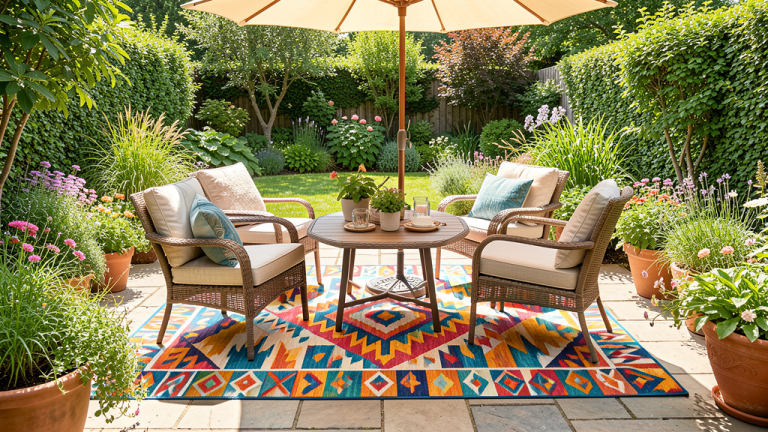
Nothing transforms a bare concrete slab or wooden deck faster than a well-chosen outdoor rug. It creates a defined zone, adds warmth underfoot, and pulls the furniture grouping together visually. Polypropylene rugs are the gold standard for outdoor use — they’re stain-resistant, quick-drying, mold-resistant, and fade-resistant in UV.
For most patios, a 5×8 or 8×10 rug hits the sweet spot. Go bigger if your seating group allows, since a too-small rug is one of the most common outdoor design mistakes. Geometric patterns and neutral stripes tend to look best in outdoor settings and hide dirt between cleanings. Brands like Mohawk Home, Safavieh, and nuLOOM offer strong options in this price range through Amazon and big-box retailers.
Pro tip: anchor rugs with furniture legs on all four corners so they don’t curl or blow in wind — no rug clips needed.
3. String Lights for Instant Ambiance ($25–$60)
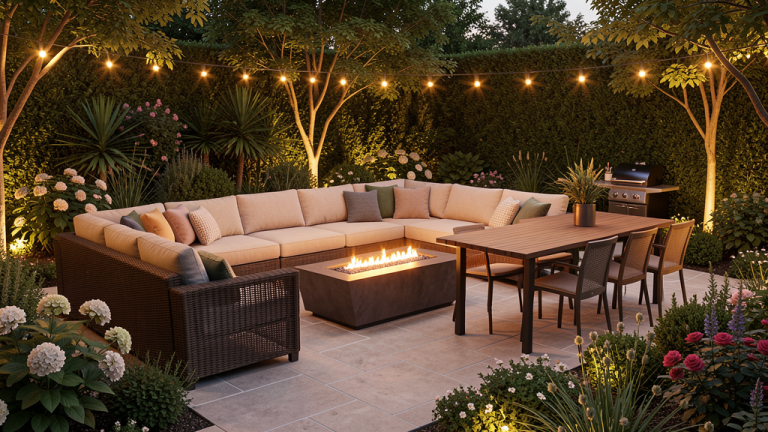
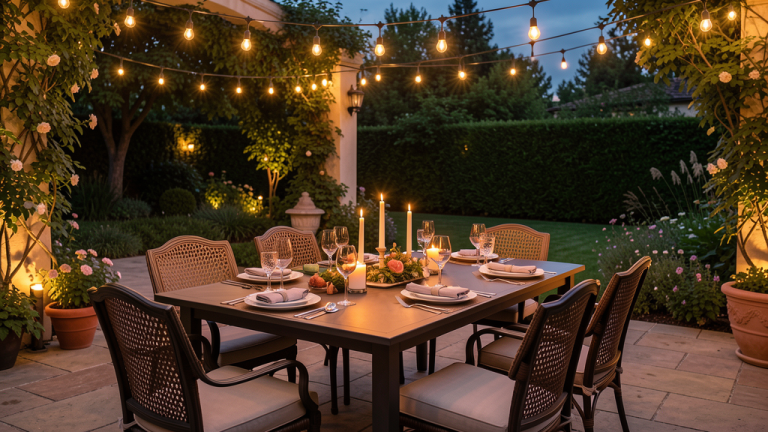
This is the highest-return investment on this list. A single strand of outdoor string lights — strung between fence posts, overhead hooks, or a simple DIY post setup — completely changes the feel of a patio after dark. Suddenly the space is usable after sunset, which practically doubles your outdoor living hours.
Solar-powered string lights eliminate the need for outdoor outlets and extension cords. However, plug-in LED globe lights on a timer are brighter and more consistent, especially in partly-shaded yards where solar panels don’t charge fully. Either way, look for shatterproof bulbs and a minimum 25-foot strand to span most standard patio configurations.
Budget for one or two strands ($25–$60 total) and a set of screw-in hooks if you’re attaching to a fence or siding. Total installation time: under an hour. Total impact: significant.
Shop String Lights on Amazon →
4. A Folding Patio Table That Actually Fits ($50–$120)
If your seating set didn’t include a center table, or if you need a surface for dining rather than lounging, a standalone folding table is a smart, flexible addition. Folding tables let you reconfigure the space easily — dining mode for Saturday cookouts, lounge mode for weekday evenings — without buying two separate furniture configurations.
Aluminum and powder-coated steel tables in the 30–36 inch diameter range work well for most residential patios. A bistro table with two chairs is often enough for a couple or compact space, and it can be had for well under $150 including chairs. Look for tables with leveling feet or adjustable legs for uneven surfaces, which is more common than you’d think on outdoor slabs.
If you already have seating, a simple weather-resistant side table (acacia, teak-look, or wicker) at $30–$50 handles drinks and remotes without dominating the footprint.
5. Planters and Greenery for Life and Privacy ($60–$150)
Plants do two things at once: they make the space feel alive and — when placed strategically — they create natural privacy screens without permanent structures. Tall planters with ornamental grasses, bamboo, or climbing plants along a fence line can block sightlines to neighbors without a single post or permit.
Budget for two to four large planters ($15–$40 each for fiberglass or resin options that look like ceramic) and fill them with low-maintenance selections: ornamental grasses, lantana, salvia, or rosemary depending on your region. These are all drought-tolerant and come back reliably. For patios in Texas, Oklahoma, or similarly hot climates, choose heat-tolerant species over shade-loving plants unless your patio gets real shade.
affiliate linkA small herb planter on the table adds function — fresh mint for cocktails, basil for cooking — and costs under $20 to set up.
Shop Outdoor Planters on Amazon →
6. A Budget Shade Solution ($60–$200)
Shade is the single upgrade that most affects how much you actually use your patio. Without it, summer afternoons in most of the U.S. are simply too hot for comfort. The good news: shade doesn’t have to mean a permanent pergola or expensive installation.
A cantilever or offset patio umbrella in the $80–$150 range delivers real shade without drilling into any surface. Look for UV-blocking fabric (UPF 50+ is the benchmark), a sturdy base weight of at least 50 lbs, and a crank-and-tilt mechanism so you can angle the canopy as the sun moves. Alternatively, a shade sail in the $40–$80 range mounts between anchor points — fence posts, hooks on the house, or freestanding poles — and covers a larger area at lower cost.
For permanent shade or a more polished look, that’s where a professional pergola or shade structure becomes worth the investment — but it moves you well past the $1,000 budget point.
Shop Patio Umbrellas on Amazon →
Buying Guide: How to Stretch $1,000 Without Compromising Quality
The most common mistake in budget patio builds is spending too much on one category and shortchanging everything else. Here’s a practical allocation for a complete $1,000 setup:
- Seating set: $200–$300 — this is your anchor piece; don’t go cheaper than $150 or durability suffers
- Shade (umbrella or sail): $80–$150 — non-negotiable for warm climates
- Outdoor rug: $50–$90 — the highest visual return per dollar on this list
- String lights: $30–$60 — transforms evening usability
- Table/surfaces: $50–$120 — fold-flat options preserve flexibility
- Planters and plants: $60–$150 — adds life, privacy, and character
- Accessories (pillows, lanterns, side table): $50–$100 — pulls it all together
Total range: $520–$970 — leaving buffer for a seasonal clearance splurge or an unexpected replacement.
Where to shop: Amazon, Wayfair, Target, IKEA, and Home Depot all carry outdoor furniture in this budget range. End-of-season sales in August and September often discount items 30–50%, making that the smartest time to buy for next year. Facebook Marketplace is also a legitimate source for high-quality secondhand furniture that just needs new cushions — often saving $100–$200 on quality pieces.
What to skip: Matching “sets” from discount outlets that sell seating, table, and umbrella as one package rarely save money compared to mixing and matching from separate sources. The umbrella is almost always cheap and the cushions are thin. Buy pieces individually.
Frequently Asked Questions
Can you really build a complete patio setup for under $1,000?
Yes — with realistic expectations. You won’t get teak furniture or a motorized pergola, but you can absolutely build a comfortable, attractive, functional outdoor space for a full family. Prioritize comfort (seating) and usability (shade, lighting) over appearance, and the aesthetics will follow naturally.
What’s the single best upgrade for a neglected patio?
If we had to pick one: an outdoor rug. It immediately defines the space, adds warmth, and makes even plain concrete feel intentional. String lights are a close second for sheer transformation-per-dollar. Do both for under $120 combined and the patio already feels different.
What outdoor furniture materials hold up best in the budget range?
Powder-coated steel and aluminum are the most durable at this price point and don’t warp, splinter, or rot. Resin wicker (polyethylene wrapped over aluminum) looks great and weathers well. Avoid raw wood without proper sealing treatment — it’s high-maintenance and often disappoints in humid or rainy climates. Genuine teak is worth it but starts above $300 for a single chair at quality entry points.
Do I need to seal or protect concrete before setting up patio furniture?
Not necessarily, but a simple concrete sealer ($20–$40 for a one-car-garage-sized area) reduces staining from furniture legs, planters, and rain. If you have cracks or surface erosion, a leveling compound from a hardware store is a worthwhile investment before putting down furniture or rugs. Neither is required to get started, but both improve longevity.
Bottom Line
A great patio doesn’t require a big budget — it requires the right sequence of investments. Start with comfortable seating, add shade, lay down a rug, hang some lights, and fill in with plants and surfaces. Do it in that order and you’ll end up with an outdoor space that gets used weekly, not just on special occasions.
Every product category above has solid options in the $50–$300 range that will last three to five seasons with reasonable care. Use the Amazon links throughout this guide to check current pricing and availability — deals shift frequently and you may find even better options at the moment you’re shopping.
The patio you build for $800 this weekend will be the place you end up spending every summer evening. That’s a return on investment that’s hard to beat.
Disclosure: This post contains affiliate links. As an Amazon Associate and Vevor affiliate, Cabana Culture earns from qualifying purchases at no extra cost to you. See our full affiliate disclosure.