Three-Season Room vs Four-Season Room — Cost, Comfort, and Which One to Build
Quick Answer
A three-season room is an enclosed porch with screened or vinyl windows that works spring through fall — typically $15,000–$40,000 installed. A four-season room is a fully insulated, HVAC-connected addition you can use year-round — typically $30,000–$80,000+. If you live in a mild climate and want a budget-friendly outdoor living space, go three-season. If you want a true year-round room that adds home value, go four-season.
Our Top Picks at a Glance
| Product | Price Range | Where to Buy | Best For |
|---|---|---|---|
| VEVOR Hardtop Gazebo 10×12ft | ~$399–$599 | Vevor | Budget 3-season upgrade |
| VEVOR Screen House Tent 12×10ft | ~$189–$249 | Vevor | Entry-level screened space |
| Palram-Canopia Feria Patio Cover | ~$699–$1,299 | Amazon | Semi-permanent patio enclosure |
| Quictent Screen House for Patio | ~$109–$179 | Amazon | Portable 3-season room feel |
| Rion Sun Room 2 Prefab Kit | ~$3,500–$5,500 | Amazon | DIY permanent sunroom kit |
Three-Season Room vs Four-Season Room — Full Breakdown
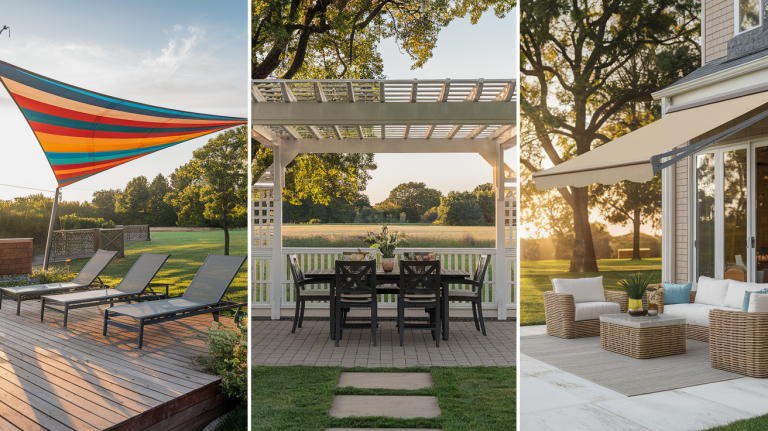
Choosing between a three-season room and a four-season room is one of the biggest decisions in backyard living. Both add enclosed, comfortable space to your home — but the costs, construction requirements, and year-round usability differ dramatically. Before we get into specific products, it helps to understand what defines each type. If you’re weighing other shade structure options, check out our comparison of shade sails, pergolas, and retractable awnings for a broader look at outdoor coverage options.
What Is a Three-Season Room?
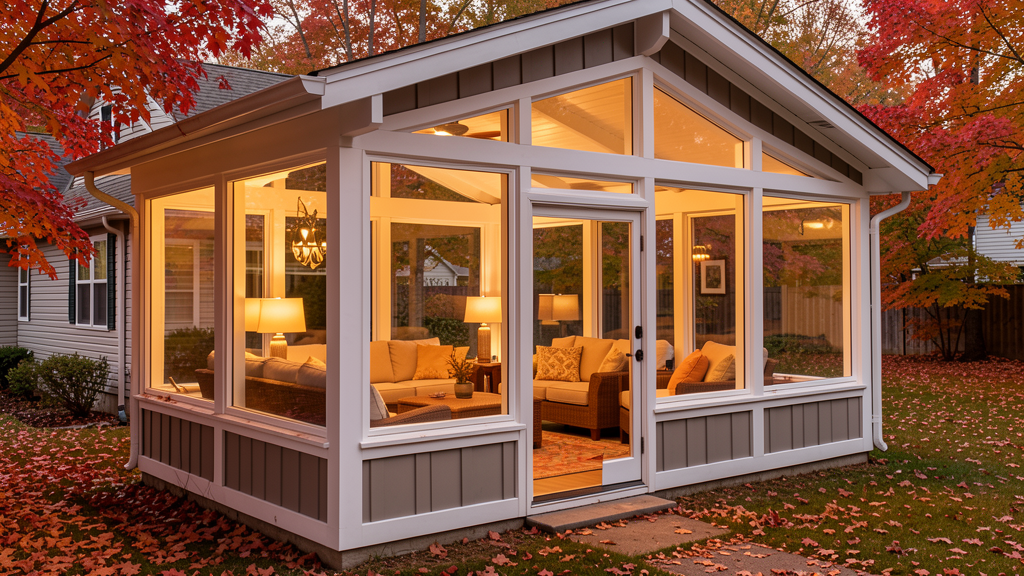
A three-season room (also called a screen room, screened porch, or sunroom) is an enclosed porch that’s open to the elements but protected by screens, vinyl windows, or lightweight glazing. These rooms are designed for use in spring, summer, and fall — typically in temperatures above 40°F. They do not have HVAC systems and are not insulated for winter use in cold climates.
Key features: Screens or single-pane windows, no heating/cooling, lower construction cost, lighter structural requirements, often DIY-friendly with prefab kits.
What Is a Four-Season Room?
A four-season room (also called an all-season room, sunroom addition, or conservatory) is a fully enclosed, insulated room addition with HVAC, double- or triple-pane windows, proper foundations, and building permits. It’s essentially a glass room addition to your home — livable in January just as much as July.
Key features: Full insulation, HVAC connection, energy-efficient windows, building permit required, adds assessed home value, significant construction cost.
1. VEVOR Hardtop Gazebo with Netting — Best Starter Three-Season Space
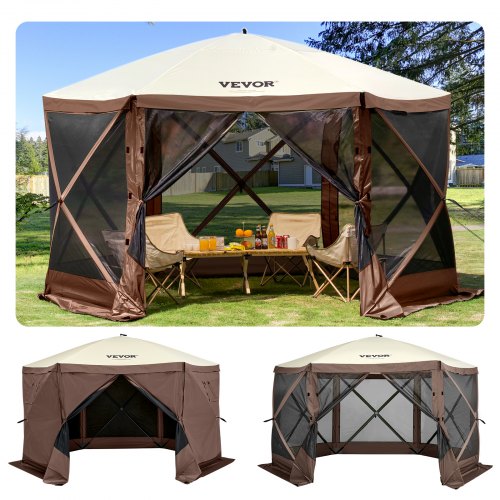
Price: ~$399–$599 | Shop VEVOR Gazebos →
- Powder-coated aluminum frame — rust-proof and weatherproof
- Dual-layer galvanized steel canopy roof
- Comes with removable mosquito netting on all sides
- 10×12ft footprint fits most patios and decks
- No permit required in most jurisdictions
- Sets up in a few hours with basic tools
If a full three-season room addition is out of budget, a hardtop gazebo with mosquito netting from VEVOR delivers a very similar experience for a fraction of the cost. You get a protected, insect-free outdoor room that works from March through November in most climates. VEVOR’s 30-day cookie and 10% commission also makes this one of the better affiliate opportunities in the outdoor living space.
2. Quictent Screened Canopy Tent — Most Versatile Portable Option

Price: ~$109–$179 | Check Price on Amazon →
- Fully enclosed mesh sides — keeps out mosquitoes, flies, and gnats
- Waterproof 150D Oxford fabric roof
- Available in 10×10ft and 10×20ft sizes
- 4.3 stars with thousands of Amazon reviews
- Stakes and guy ropes included for wind stability
- Sets up and tears down in 30 minutes
For renters or homeowners who don’t want a permanent structure, the Quictent screened canopy tent gives you the three-season room experience without any construction. It’s a smart choice for camping, backyard parties, or testing the concept before committing to a permanent build. This is one of the most popular screened shelter options on Amazon for good reason.
3. VEVOR Screen House Tent — Best Budget Screened Enclosure
Price: ~$189–$249 | Shop VEVOR Screen Houses →
- Full mesh screening on all sides for insect protection
- Reinforced steel poles with easy push-button assembly
- 12×10ft footprint — fits 6–8 people comfortably
- UV-resistant canopy roof with vented top for airflow
- Zippered doors on multiple sides
- Carry bag included for storage
VEVOR’s screen house collection delivers solid quality at competitive prices compared to big-box brands. The 12×10ft footprint works well as a temporary three-season room on a deck or patio, and the steel pole construction is noticeably more durable than cheaper pop-up designs. It’s a great step between a canopy and a permanent screened porch addition.
4. Palram-Canopia Feria Patio Cover — Best Semi-Permanent Enclosure

Price: ~$699–$1,299 | Check Price on Amazon →
- Commercial-grade aluminum frame — won’t rust or rot
- Twin-wall polycarbonate roof panels (97% UV protection)
- Available in 12×9ft, 15×9ft, and 18×9ft sizes
- Lean-to design attaches to home exterior
- Rated for 27 lbs/sq ft snow load and 55 mph wind
- Can be enclosed with Palram’s optional side panels
Palram-Canopia is the leading name in prefab patio enclosures, and the Feria cover is their flagship lean-to system. When paired with optional side panels and screen kits, it becomes a genuine three-season room for a fraction of the cost of a custom build. The polycarbonate roof provides excellent light diffusion while blocking virtually all UV rays — critical for furniture protection and comfortable temperatures. For ideas on how to outfit the space inside, our guide to the best patio furniture sets of 2026 covers weather-resistant options that work perfectly in a three-season room.
5. Rion Sun Room 2 Prefab Sunroom Kit — Best DIY Four-Season Option

Price: ~$3,500–$5,500 | Check Price on Amazon →
- UV-stabilized polycarbonate panels — won’t yellow over time
- Hot-dipped galvanized steel frame
- Available in multiple sizes from 8×12ft to 8×20ft
- Double-wall panels provide moderate insulation
- Suitable for lean-to or freestanding installation
- Can be expanded with additional sections
The Rion Sun Room 2 is about as close as you can get to a true four-season room in a DIY prefab kit. The double-wall polycarbonate construction provides real insulation value, and combined with a small space heater or mini-split, many homeowners use it year-round in mild climates. It won’t match the energy efficiency of a fully permitted addition, but at 10–20% of that cost, it’s an impressive compromise for the budget-conscious builder.
Buying Guide — What to Look For
Climate: The Single Biggest Factor
Your local climate determines which type of room makes financial sense. In Texas, Florida, or Southern California, a well-built three-season room (or a four-season room without heating requirements) works brilliantly for 10+ months of the year. In Minnesota, Ohio, or upstate New York, you’ll need full insulation and HVAC to get real use from November through March. Don’t overbuild for a climate that doesn’t demand it — but don’t underbuild either. If you’re in the Dallas-Fort Worth area, our piece on the best pergolas for Texas heat shows what shade structures are designed to handle extreme summer conditions.
Permits and HOA Requirements
Three-season rooms attached to your home almost always require a building permit, even if they’re simple. Four-season rooms always require permits and often HOA approval. Freestanding structures under a certain square footage (typically 200 sq ft) may be exempt in many jurisdictions — always check local codes before you build. Prefab or portable structures like gazebos and screen houses generally don’t require permits, which is one of their key advantages.
Foundation Requirements
Three-season rooms can sometimes be built on existing concrete patios or deck structures with minimal additional foundation work. Four-season rooms typically require footings below the frost line — which means excavation, concrete, and significant additional cost. In cold climates, foundation work alone can add $5,000–$15,000 to a four-season room project. This is one reason why getting accurate contractor quotes early is essential. If you’re planning a professionally installed shade structure or outdoor room in DFW or Austin, our guide to pergola installation costs in 2026 gives useful benchmarks for what professional outdoor construction actually costs.
Energy Efficiency and Windows
Four-season rooms live and die by their window quality. Low-E double-pane or triple-pane glass is the minimum standard for energy efficiency in a heated/cooled space. Look for a U-factor below 0.30 and a solar heat gain coefficient (SHGC) of 0.25–0.40 for most climates. Three-season rooms can get away with tempered single-pane glass or even just heavy-duty screens, dramatically reducing cost.
Frequently Asked Questions
How much does a three-season room cost installed?
A professionally installed three-season room typically costs $15,000–$40,000 depending on size, materials, and local labor rates. Smaller screen porch conversions can be done for $8,000–$12,000. DIY prefab kits like the Palram Feria or Rion Sun Room can achieve a similar result for $1,000–$6,000 in materials, though they’ll lack some of the fit-and-finish of a custom build.
Does a four-season room add home value?
Yes — a well-built four-season room typically returns 50–70% of its cost in added home value according to Remodeling Magazine’s Cost vs. Value report. Because it’s a permitted addition that increases square footage, it often counts toward the home’s appraised value. A three-season room typically adds less assessed value but can still make a home more attractive to buyers in warmer climates.
Can you convert a three-season room to a four-season room?
Yes, but the conversion is often expensive. You’ll typically need to: (1) upgrade windows to insulated double-pane units, (2) add wall insulation, (3) install a heating and cooling source (mini-split is most common), and (4) pull a permit. Total conversion cost typically runs $10,000–$25,000 depending on the existing structure’s condition.
What’s the difference between a sunroom and a three-season room?
The terms are often used interchangeably, but technically: a sunroom uses glass (not screens) for the walls, while a three-season room may use screens or vinyl windows. A four-season sunroom is fully insulated and climate-controlled. In practice, what matters most is the insulation and HVAC setup, not the exact terminology used by the contractor.
Bottom Line
For most homeowners in mild climates, a three-season room — or even a high-quality hardtop gazebo with screened sides — delivers 80% of the four-season experience at 20–30% of the cost. If you live in a cold climate or want the space to function as genuine living square footage year-round, the four-season room investment pays off. Start with your climate, set your budget, and work backward from there. If you want to explore the full range of shade and enclosure options for your backyard before committing, our comprehensive guide to the best shade structures for 2026 covers everything from pergolas to retractable systems.
Cabana Theory specializes in premium shade structures and outdoor living spaces — including screened rooms, pergolas, and patio enclosures. Get a free quote today.
Cabana Culture participates in affiliate programs including Amazon Associates and the Vevor affiliate program. We may earn a commission at no extra cost to you. See our full disclosure.
Disclosure: This post contains affiliate links. As an Amazon Associate and Vevor affiliate, Cabana Culture earns from qualifying purchases at no extra cost to you. See our full affiliate disclosure.
Disclosure: This post contains affiliate links. As an Amazon Associate and Vevor affiliate, Cabana Culture earns from qualifying purchases at no extra cost to you. See our full affiliate disclosure.